Makaveli: 30 Years of the Album “The 7 Day Theory”
On this day, November 5, 1996, less than two months after his tragic murder in Las Vegas, the world received the final album completed during the lifetime of Tupac Shakur, released under his newly unveiled alias Makaveli — the legendary The Don Killuminati: The 7 Day Theory. Issued through Makaveli Records, Death Row Records, and Interscope Records, the LP arrived while the global music community was still paralyzed by grief and shock. Exactly thirty years later, this monumental work endures not only as the darkest, rawest, and most prophetic document in Shakur’s discography, but as an untouchable hip-hop masterpiece that redefined cinematic street theology.
The Seven Day Theory: Rapid Creation and the Birth of Makaveli
The mythology surrounding the album is deeply rooted in its astonishing speed of execution. The subtitle The 7 Day Theory was no promotional exaggeration: Tupac Shakur conceived, wrote, and recorded all of his verses and vocals in a torrid three-day burst during August 1996 at Can-Am Studios in Tarzana, California. Studio engineer Tommy D. Daugherty recalled that Shakur worked with supernatural focus, writing lyrics on yellow legal pads in under twenty minutes and nailing first takes, while the engineering staff spent four subsequent days mixing the master tapes. Those seven days yielded twelve songs of unprecedented emotional ferocity. Departing radically from the polished, big-budget G-funk bounce of his diamond-certified double album All Eyez on Me, Pac deliberately embraced a claustrophobic, combative, and stripped-down sonic atmosphere.
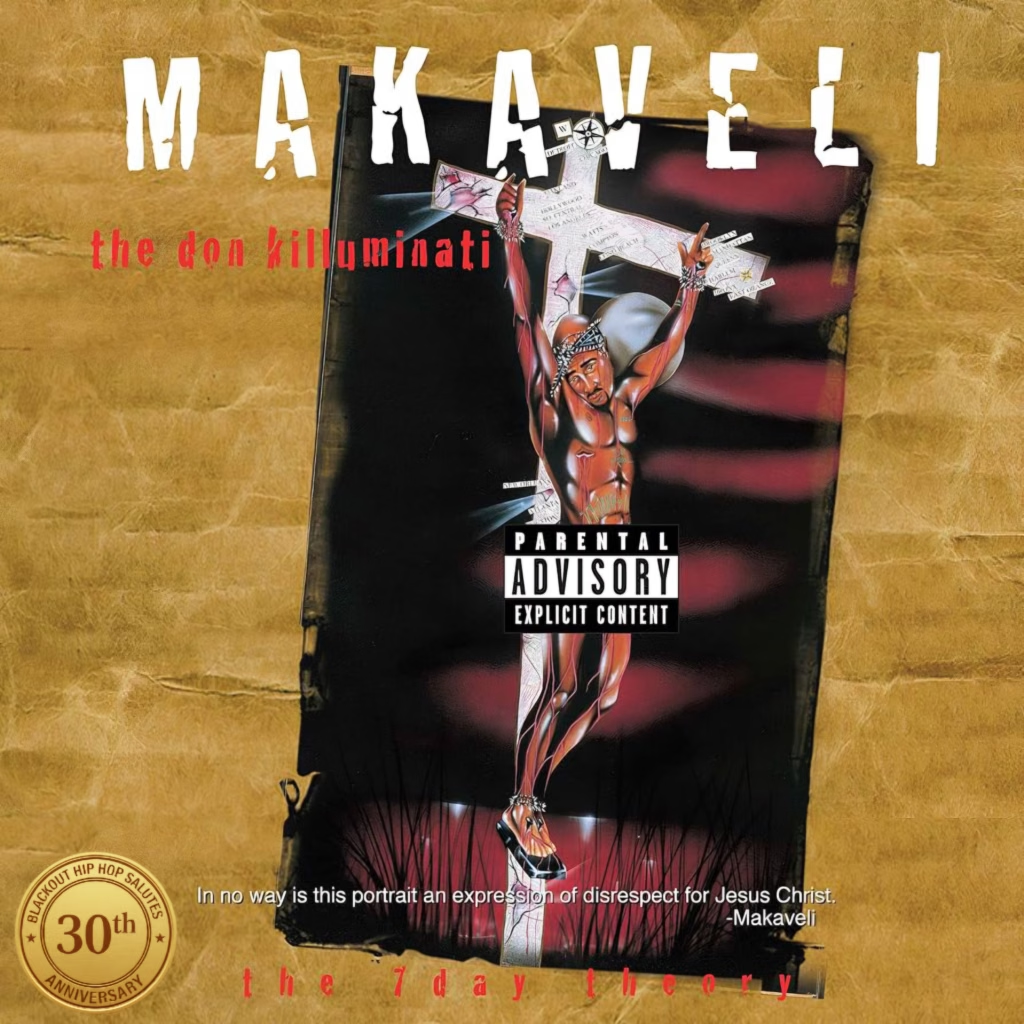
Adopting the moniker Makaveli reflected his deep intellectual immersion in the political writings of Niccolò Machiavelli, whose foundational treatise *The Prince* Shakur devoured while incarcerated at Clinton Correctional Facility in 1995. The new persona represented a calculating strategist preparing to launch his own imprint, Makaveli Records, and gradually detach from the perilous orbit of Suge Knight. The provocative cover art, painted by Compton artist Ronald “Riskie” Brent, depicted Pac crucified on a cross—accompanied by an explicit disclaimer stating that the imagery represented his public and media crucifixion rather than any disrespect to Jesus Christ.
Underground Architecture: The Boardwork of Hurt-M-Badd and QDIII
Rather than enlisting multi-platinum architects like Dr. Dre or Daz Dillinger, Makaveli entrusted the album’s soundscapes to lesser-known in-house producers who were completely dedicated to his vision. The primary musical engine of the project was Tyrone Wrice, known professionally as Hurt-M-Badd, who produced five pivotal tracks. His signature aesthetic—characterized by haunting funeral bells, sparse percussion, and somber basslines—provided the ideal canvas for Pac’s apocalyptic state of mind.
The definitive triumph of their collaboration is the immortal anthem „Hail Mary”, widely regarded as one of the greatest rap recordings of all time. Completed in less than an hour, the track pairs Pac’s hypnotic whispered cadence with thunderous drums and militant guest verses from his loyal group Outlawz, featuring Kastro and Young Noble, framed by the haunting reggae incantations of Prince Ital Joe. The ominous tolling bell transformed the song into a permanent cultural prayer that continues to echo through urban landscapes worldwide.
Providing a striking emotional contrast is the album’s second single, „To Live & Die in L.A.”, masterfully produced by QDIII. Interpolating Prince’s classic “Do Me, Baby” alongside backing vocals from songstress Val Young, the track stands as a sun-drenched, affectionate love letter to Los Angeles, capturing the beauty, pride, and ever-present danger of West Coast street culture.
The sonic tapestry is rounded out by key contributors: producer Darryl Harper laced the kinetic, bass-heavy diss cut „Toss It Up” (featuring Danny Boy, Aaron Hall, and K-Ci & JoJo) alongside the relentless posse cut „Life of an Outlaw”, which featured Outlawz members including E.D.I. Mean and the late Yaki Kadafi. Meanwhile, Big D The Impossible provided warm, reflective instrumentation for „Krazy” and „White Man’z World”. Every production choice felt intentionally austere, ensuring that Pac’s commanding voice remained the absolute focal point of the sonic spectrum.
Lyrical Warfare, Paranoia, and Spiritual Confessions
Lyrically, The Don Killuminati: The 7 Day Theory presents the most intense psychological portrait of Tupac Shakur’s artistry. Operating with the urgency of a prophet conscious of his impending demise, Pac delivered rhymes steeped in righteous fury, betrayal, and metaphysical longing. The opening salvo, „Bomb First (My Second Reply)”, opens with a simulated flatlining heartbeat and news broadcast before exploding into a vicious verbal assault targeting East Coast adversaries including The Notorious B.I.G., Puff Daddy, Mobb Deep, and Jay-Z. The combative arc concludes with „Against All Odds”, widely considered the most lethal diss track of his career, which carried an even colder, more strategic psychological edge than “Hit ‘Em Up”.
Yet reducing the record merely to warfare misses its profound spiritual core. On „Blasphemy”, Makaveli wrestles with religious dogma, divine retribution, and street mortality, while „Hold Ya Head” offers an aching sanctuary of empathy for prisoners and marginalized communities. The pinnacle of his songwriting genius arrives on „Me and My Girlfriend”, an astonishing extended metaphor wherein Pac personifies his firearm as his only loyal companion in a treacherous world. On „White Man’z World”, he extends an eloquent tribute to Black mothers and political prisoners, shouting out revolutionary figures like Assata Shakur and Nelson Mandela.
Commercial Dominance, Mythology, and Three Decades of Legacy
Upon its arrival in stores in November 1996, the album produced immediate shockwaves across the music industry. It debuted at number one on the Billboard 200, moving over 664,000 copies in its first week alone and remaining atop the charts for consecutive weeks on its way to quadrupling platinum status with over eight million copies sold worldwide. The haunting circumstances of its release—recorded in seven days, Pac shot on September 7 and passing away at 4:03 (4+0+3=7)—fueled an enduring mythology that had fans speculating whether Shakur had staged his death in homage to Machiavelli, deepened further when Yaki Kadafi was murdered just five days after the album hit shelves.
Thirty years after its release, The Don Killuminati: The 7 Day Theory endures as the ultimate testament to the revolutionary intensity of Tupac Shakur. It was his final self-curated artistic statement—angry, sorrowful, prophetic, and completely uncompromising. The album stands as a cornerstone of hip-hop history that permanently cemented Makaveli as an immortal titan whose resonance continues to inspire generations across the globe.