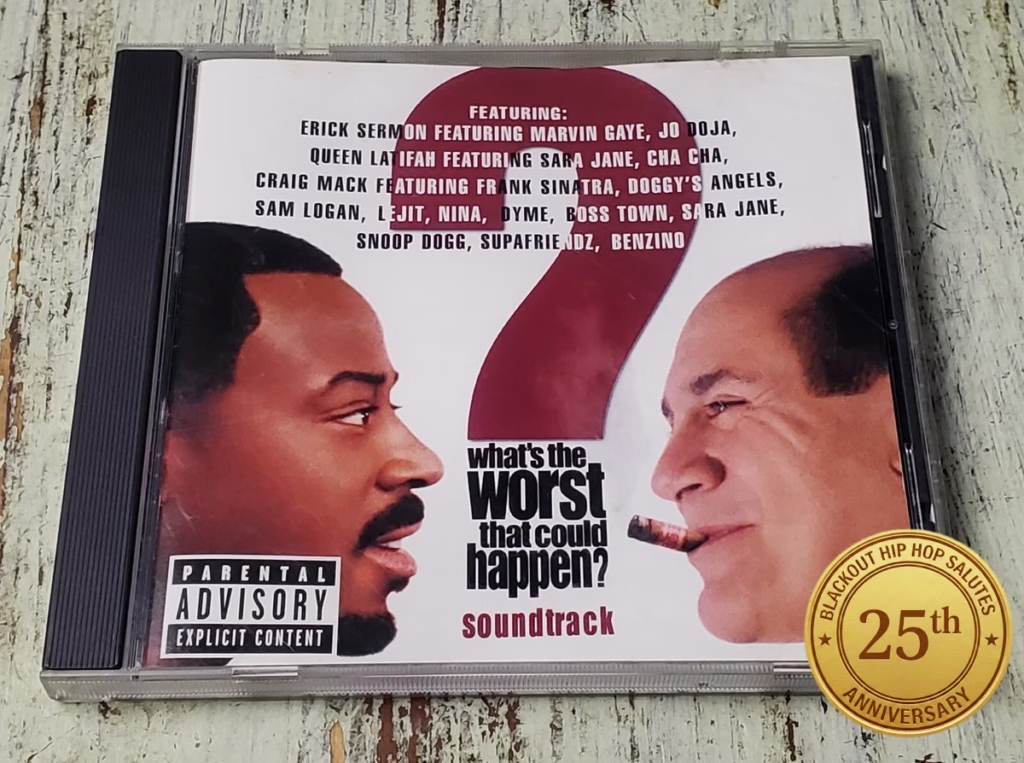
25 Years of What’s the Worst That Could Happen? OST
The Movie Flopped, But the Soundtrack Stayed Alive
The 2001 comedy What’s the Worst That Could Happen?, starring Martin Lawrence and Danny DeVito, is rarely mentioned with praise today. Carrying a hefty budget of $60 million, the film struggled to claw back a meager $38.4 million at the global box office and was thoroughly panned by critics, earning a disappointing 10% rating on Rotten Tomatoes. However, that era had an unwritten rule in Hollywood that often saved record labels: even if a movie completely tanked in theaters, the accompanying soundtrack could still go on to become an absolute classic and a major club staple.
That is exactly what went down on May 29, 2001, when the independent label NY.LA Music, with major backing from Interscope Records and Universal Distribution, dropped the official soundtrack. Guided by executive music supervisor Eric B. (from Eric B. & Rakim), the project was guaranteed street credibility and top-tier talent. Today, we are celebrating the 25th anniversary of this release, which stands as a great reminder of a time when soundtrack compilations had a genuine life of their own outside of the multiplexes.
How Erick Sermon Struck Gold with “Music”
If you ask any hip-hop head about this soundtrack, they will immediately point to one specific track: “Music“. Erick Sermon, one-half of the legendary duo EPMD, cooked up a straight-up masterpiece that breathed new life into his solo career. The backstory is legendary: Sermon acquired an unreleased acapella of Marvin Gaye‘s vocals from the Midnight Love and “Sexual Healing” sessions. Sermon immediately recognized the magic. In just one night, utilizing the legendary Roland W-30 sampler, Sermon crafted a hypnotic, bass-heavy boom-bap rhythm around Gaye’s 15-second vocal loop.
The result was a seamless, soul-stirring fusion of classic East Coast boom-bap and timeless Motown soul. Released as a single on June 12, 2001, “Music” became a massive global hit, peaking at No. 22 on the Billboard Hot 100, No. 2 on the Hot R&B/Hip-Hop Songs chart, and No. 4 on the Hot Rap Songs chart. The buzz was so intense that it landed Sermon a lucrative $3 million deal with Clive Davis’s newly established J Records. Sermon eventually leveraged this momentum to build his entire fourth solo album around the track, also titled Music, which dropped later that fall. The music video became an MTV staple, and the song remains a timeless classic of early 2000s sample-based production.
Left-Field Sample Flips and Unlikely Pairings
This soundtrack served as a playground for eccentric and bold production choices. The most peculiar track on the tracklist is “Wooden Horse” by the late Bad Boy pioneer Craig Mack, featuring an unexpected “guest appearance” from Frank Sinatra. Producer The 45 King flipped Sinatra’s version of “High Hopes” to construct a bouncing, quirky backdrop. Although released as the album’s first promo single in late 2000, it failed to chart or recapture the massive commercial momentum Craig Mack had in the mid-90s with “Flava in Ya Ear“. Nonetheless, “Wooden Horse” remains a highly regarded underground classic among crate-diggers for its sheer audacity.
The album continued this trend of mixing hip-hop grit with vintage jazz and show tunes. Jo Doja’s “Whatever Jo Wants (Jo Gets),” produced by the Virginia duo Bill McGee and Danja Mowf, cleverly loops Sarah Vaughan’s jazz classic “Whatever Lola Wants”. The 45 King stepped behind the boards again for Dyme’s “Ladies Are U Wit Me,” flipping a sample from the Broadway musical South Pacific (“I’m Gonna Wash That Man Right Outa My Hair”). These creative risks showed that the production team wasn’t just aiming for generic radio play; they were genuinely trying to push the boundaries of how samples were utilized on commercial soundtracks.
Street Heat and the Ladies Holding it Down
The soundtrack also made sure to provide plenty of street-level heat. Snoop Dogg kicks off the tracklist with “Fuck What They Say” (produced by Meech Wells and Keith Clizark), bringing that classic, laid-back West Coast ride. A similar sound continues with Doggy’s Angels on the energetic “Shoot ‘Em Up“. We also get a taste of Virginia hip-hop through the group Supafriendz, which originally consisted of Mad Skillz, Danja Mowf, and Lonnie B. They delivered the movie’s titular track “What’s the Worst That Could Happen?” alongside Jo Doja and Shawn Chappelle.
On the East Coast front, Benzino contributed the club-friendly banger “Bang ta Dis,” handled by his Boston production team Hangmen 3. Benzino (co-founder of The Source magazine) used the track to promote his debut solo LP, The Benzino Project. While Benzino was never hailed as a top-tier lyricist, “Bang ta Dis” did its job in the clubs and kept his name buzzing on the mixtape circuit.
Furthermore, female artists played a major role in shaping the album’s sound. Detroit-bred rapper Cha Cha delivered the fierce “Stick ‘Em,” produced by Devyne Stephens. Though the single didn’t chart highly , it added an aggressive edge. Queen Latifah also made a grand appearance, teaming up with Sara Jane on the beautiful, uplifting “Everywhere You Go,” injecting a healthy dose of soulful R&B into the project. Additionally, Sara Jane delivered the solo effort “No Job,” produced by Lloyd Crucial.
Chart Performance and Legacy after 25 Years
Even though the movie was a certified critical and commercial disaster , the soundtrack carved out its own successful path on the Billboard charts. It peaked at No. 38 on the Billboard 200, No. 6 on the Top R&B/Hip-Hop Albums, and No. 11 on the Top Soundtracks chart.
Revisiting this project 25 years later offers a nostalgic window into a transitional era of hip-hop. It was a time when major labels had the budgets to clear high-profile samples of Marvin Gaye and Frank Sinatra, and when soundtrack compilations were treated as essential, standalone bodies of work rather than mere promotional tools. Whether you’ve watched the film or not, the soundtrack remains a worthy spin for Erick Sermon’s timeless hit.