“De La Soul Is Dead” is 35: The Death of the D.A.I.S.Y. Era
De La Soul Is Dead: Three and a Half Decades of the Boldest “Suicide” in Hip-Hop History
Today is May 14, 2026. Exactly 35 years ago, the world witnessed the birth of one of the strangest, darkest, and perhaps most vital albums of the Golden Era. When Posdnuos, Trugoy the Dove, and Maseo entered the studio with Prince Paul to record the follow-up to their mega-successful debut 3 Feet High and Rising, nobody expected their answer to fame would be – their own death. De La Soul Is Dead wasn’t just a record; it was a manifesto of artistic freedom and a direct punch to the gut of a music industry that tried to pigeonhole them as “hip-hop hippies.”
The Context: How to Kill a Flower?
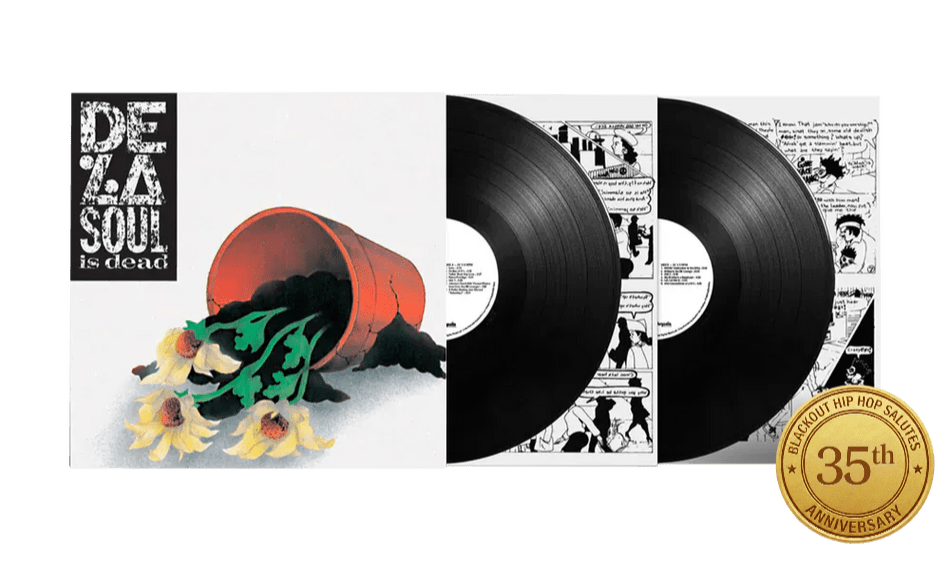
After bringing colors, peace, and the “D.A.I.S.Y. Age” (Da Inner Sound, Y’all) philosophy to a genre dominated by the dark tones of Public Enemy and N.W.A in 1989, De La Soul became critical darlings, but also victims of their own branding. The media pushed them as gentle guys with flowers, ignoring their sharp lyrical edge. The breaking point was an appearance on The Arsenio Hall Show in 1989, where the host introduced them as the “hippies of hip-hop.” That moment, where their art was reduced to a visual cliché, directly inspired the second album’s cover: a flower pot with three wilting daisies, shattered on the ground. The message was clear – the era of innocence was over.
Prince Paul’s Production: A Sampling Masterclass
Musically, this album is the pinnacle of the group’s collaboration with producer Prince Paul. While the debut was a playful collage, De La Soul Is Dead brought a lo-fi, “grittier” sound. Using the Akai S950 sampler, Paul managed to create dense sonic layers that included nearly 100 different samples – ranging from James Brown to Tom Waits and Stevie Wonder.
The opening track “Oodles of O’s” sets the tone immediately with its hypnotic bassline, while “A Roller Skating Jam Named ‘Saturdays’” became the ultimate weekend anthem, blending a disco vibe with pure hip-hop attitude. Interestingly, even in the “happiest” songs like “Ring Ring Ring (Ha Ha Hey),” they lyrically addressed the frustrations of newfound fame and the annoying characters who chased them down with demo tapes.
Heavy Themes and Social Realism
What set this album apart from others at the time was the group’s willingness to scratch beneath the surface. “Millie Pulled a Pistol on Santa” is one of the bravest songs in the genre’s history, using dark narration to tackle the themes of incest and child abuse. On the other hand, “My Brother’s a Basehead” is a brutally honest depiction of the struggle with crack addiction within a family, told without sugarcoating and with a dose of bitter cynicism.
These tracks proved that De La Soul weren’t “soft.” On the contrary, they were ready to face the community’s traumas in a way that gangsta rappers, focused on profanity and guns, often didn’t know how to.
The Skits: Jeff and the Crew from the “BK Lounge”
We can’t talk about this album without mentioning the skits. De La Soul popularized this format, but on this release, they perfected it. Throughout the album, we follow the character of Jeff, a teenager who finds a De La Soul tape in the garbage, only to have it stolen by bullies (led by Hemorrhoid, voiced by Mista Lawnge of Black Sheep). Their constant “hating” on the tracks we are hearing is a genius meta-commentary on what the audience expected from hip-hop back then – violence and curses – and what the group was offering instead.
Legacy and Digital Resurrection
The road to today wasn’t easy. Due to legal issues with samples, this album was unavailable on streaming services for decades. It wasn’t until 2023, after the group regained control of their masters, that the world could finally legally listen to this masterpiece on digital platforms. Unfortunately, this happened shortly after the death of Trugoy (Dave), adding a layer of melancholy to the anniversary.
Although some tracks, like “Cool Breeze on the Rocks,” had to be modified due to licensing, the essence of the album remained intact. De La Soul Is Dead is an album that grows with the listener. It wasn’t a “commercial failure,” as some critics claimed at the time because it didn’t sell like the debut; it was the foundation for the longevity of a group that refused to be a passing trend.
Today, 35 years later, the pot is still shattered, but De La Soul’s music is more alive than ever. If you haven’t played at least “Keepin’ the Faith” today, you’re not a real head. Peace, love, and three daisies – even if they are wilting.