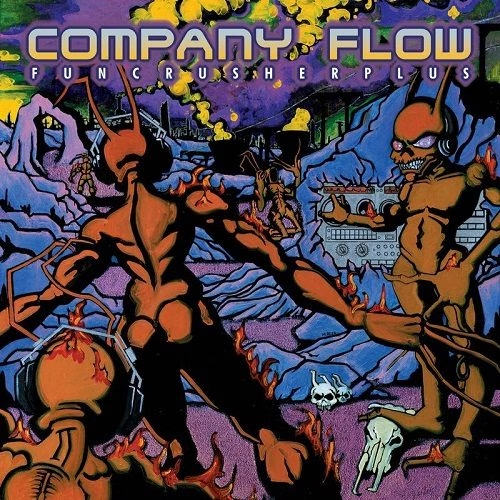
Company Flow: Funcrusher Plus – Independent as Fuck
Author : RAProgram
When the Brooklyn trio Company Flow unleashed their official debut Funcrusher Plus in July 1997, the hip-hop scene stood at a historic crossroads. On one side, the genre was experiencing an unprecedented commercial boom, yet simultaneously sinking into sonic monotony—the airwaves were ruled by shiny suits, breezy pop samples, and carefree club hits. On the other side, the disciples of the golden era were seeking refuge in the underground.
At that exact moment, El-P, Bigg Jus, and DJ Mr. Len raised their middle fingers and fired off an album that felt like a lyrical nail gun assault. The slogan “Independent as Fuck”, stamped onto their early vinyl pressings, was no marketing gimmick; it was a declaration of war against the corporate machinery and a manifesto that poured reinforced concrete into the foundations of abstract and independent rap.
Today, nearly three decades later, Funcrusher Plus stands as a unique, harsh, and deeply polarizing monument of an era.
Lyrical-Technical Profile: The Three Pillars of the Underground
Lyrically, this album is packed as relentless, wall-to-wall street battle rap, but mutated through the paranoia of Philip K. Dick, conspiracy theories, pop-culture debris, and graffiti codes. The texts are so dense and serpentine that they frequently stray completely off-meter, devolving into manic, semi-conversational tirades. Each of the group’s three members brings a specific weight that forms a singular identity:
- Bigg Jusis the titan from the shadows and a raw, b-boy classicist. His style is deeply rooted in the aesthetics of the New York subway system and aerosol art. On tracks like “Lune TNS”, Jus sounds completely natural over bizarre backdrops, firing off lyrical barrages through a filter that sounds like a street intercom.
- El-Palready profiles himself here as the architect of dystopia. His verses are aggressive, visionary, and laced with a sick, pitch-black humor.
- DJ Mr. Lenis the secret weapon and the glue holding this chaos together. While El-P and Jus held the microphones, Len’s role as a DJ and co-producer injected a much-needed dynamism into the album. His scratches were not mere window dressing, but full-fledged arrangement elements that dictated the tempo and drove tension directly into the verses. Measured and technically flawless, Len brought a crucial b-boy stability to El-P’s experimental sonic excursions.
However, this approach carries legitimate criticisms. The album occasionally suffers from “pseudo-intellectualism.” Dropping scientific terms (like covalent bonds and electrons) and flirting with global conspiracies on tracks like “Silence” or “Help Wanted” sometimes feels like a cheap rhetorical trick—thesaurus rap that sounds profound but lacks real, deep social or philosophical weight once you peel back the outer layer. Yet even when they are pretentious or lyrically impenetrable (leaving internet lyric archives riddled with question marks to this day), their wild energy and charisma turn it into pure verbal swordsmanship.
Production: A Sonic Hellscape Infected with Tetanus
If the lyrics are heavy to digest, the production by El-P and Mr. Len is what makes the album epochal. Forget warm jazz and G-funk. The beats on Funcrusher Plus are filthy, oxidized, consciously uncommercial, and deliberately non-danceable.
El-P took the old-school MPC functionalism of the early era (akin to EPMD) and collided it with psychedelic horror. Samples were ripped from obscure Mexican avant-garde films (like Jodorowsky’s The Holy Mountain), the animated adaptation of The Hobbit, and prog-rock, creating a bionic, rusted Blade Runner atmosphere.
Key Cuts, Guest Features, and Sonic Architecture:
- “Bad Touch Example“– A perfect, twisted introduction. It opens with samples from a public safety instructional record about avoiding child molestation, which out of context sounds bizarre and tasteless, but in execution sets a creepy, dystopian tone over a grimy vibraphone loop.
- “8 Steps to Perfection“and “Blind“ – Pieces closest to the boom-bap tradition, but laced with early 8-bit synthesizers and eerie guitar loops that sound unearthed from late-1960s LSD awareness educational films.
- “Population Control” – An exceptionally dark and progressive moment on the album. While the drums are slow and neck-snapping, and the matrix sounds like it was tracked inside Ed Wood’s head—full of atonal radar pings and dripping water sounds—none other than the legendary RA the Rugged Mancan be heard in the background (uncredited vocals). His unsigned madness through ad-libs brings an extra dose of unpredictability to the song’s already paranoid atmosphere. A particular treat for crate diggers is the fact that El-P utilized a sample of the theme “Gollum’s Riddle” from the cult 1977 animated film The Hobbit as the bedrock for this track, transforming high fantasy into a pure underground nightmare.
- “Vital Nerve“– A masterclass in minimalism. A simple, repetitive three-note synth riff hammered out over a heavy, battered drum break featuring a sampled Biz Markie beatbox. The sonic equivalent of punching a hole straight through a wall.
- “Collude/Intrude” (feat. J-Treds)– One of the standout tracks on the album and a true lyrical clinic. El-P and guest emcee J-Treds trade bars with grim determination, while Mr. Len cuts the track with surgically precise scratches, creating an atmosphere of mechanized, urban warfare.
- “The Fire in Which You Burn” (feat. J-Treds & Breezly Brewin)– The crown jewel of the album. Joining forces under the moniker The Indelible MCs, Company Flow, J-Treds, and Breezly Brewin (of Tha Juggaknots) march through a charred hellscape. El-P constructs a frantic rhythm consisting of slightly off-beat snares and a warped sitar snarling in the background, while all four deliver a lyrical masterclass that stands as one of the finest posse cuts of the nineties.
- “Last Good Sleep“– The emotional core of the album. Here, El-P strips away the battle-rap mask to deliver a brutally realistic tale of domestic violence and a childhood spent listening to a stepfather’s blows. The claustrophobic mix (where El-P is intentionally turned down, as if still trying to evade detection) and alarm-like echoes make this one of the heaviest tracks in hip-hop history.
- “Funcrusher Scratch“– Pure, stripped-back solo space for Mr. Len. This instrumental showcase demonstrates his impressive turntable technique over hard-hitting drums, serving as a direct precursor to what the group would later execute on their instrumental album Little Johnny From the Hospital.
Still, this approach demands a price. Over a long stretch, the album can sound repetitive and sonically “muddy.” The amateurish mix and stark minimalism of certain tracks in the second half can cause fatigue for listeners who aren’t one hundred percent dedicated to this specific palette.
Structure, Runtime, and Reissue Context
Clocking in at over 74 minutes (nearly 80 on vinyl) across 19 tracks, Funcrusher Plus is a massive, lumbering beast. It functions as an anthology of everything the group created between 1994 and 1997 (incorporating the entirety of the original Funcrusher EP and legendary freestyle moments from the Stretch and Bobbito radio show). Interestingly, while the album is overly long by modern streaming standards, it rarely feels artificially padded because each track and dark skit carries its own warped personality.
After being trapped for years in the legal limbo of Rawkus Records—a label that went from being the visionary home of Mos Def to one of the biggest disappointments in industry history—the album received a vital reissue under El-P’s own Definitive Jux imprint in 2009. That reissue proved the music had lost none of its prophetic dread. The samples from the interlude “Help Wanted”, featuring authoritarian voices broadcasting government plans to eliminate millions of citizens to save the economy, sounded just as terrifying during the global financial crisis as they did upon their inception.
Conclusion and Legacy
Funcrusher Plus is not a fun album, nor was it built for casual listening. It is a demanding, heavy, and deliberately uncomfortable record. Its influence on the subsequent evolution of hip-hop is immeasurable: without it, we would not have the Def Jux era (Aesop Rock, Cannibal Ox), Flying Lotus, or the modern, boundary-pushing expressions carried out by the likes of Danny Brown or Kendrick Lamar.
While El-P ultimately achieved global triumph and mainstream success with Killer Mike through Run The Jewels after navigating a long, rocky road, it remains a lasting underground tragedy that Bigg Jus, despite his monstrous talent and equal contribution to this masterpiece, never managed to break through the barrier of anonymity.
This album remains a sui generis entity in music history. Minor production flaws and occasional lyrical hermeticism aside, its raw courage and vision make it essential listening. Today, without a shadow of a doubt, Funcrusher Plus is rightfully considered one of the greatest, most important, and most influential underground hip-hop albums of all time. If the system ever crumbles the way they predicted, this album will be the official soundtrack to that collapse.
BARS > NUMBERS