Clipse: 20 Years of “Hell Hath No Fury”
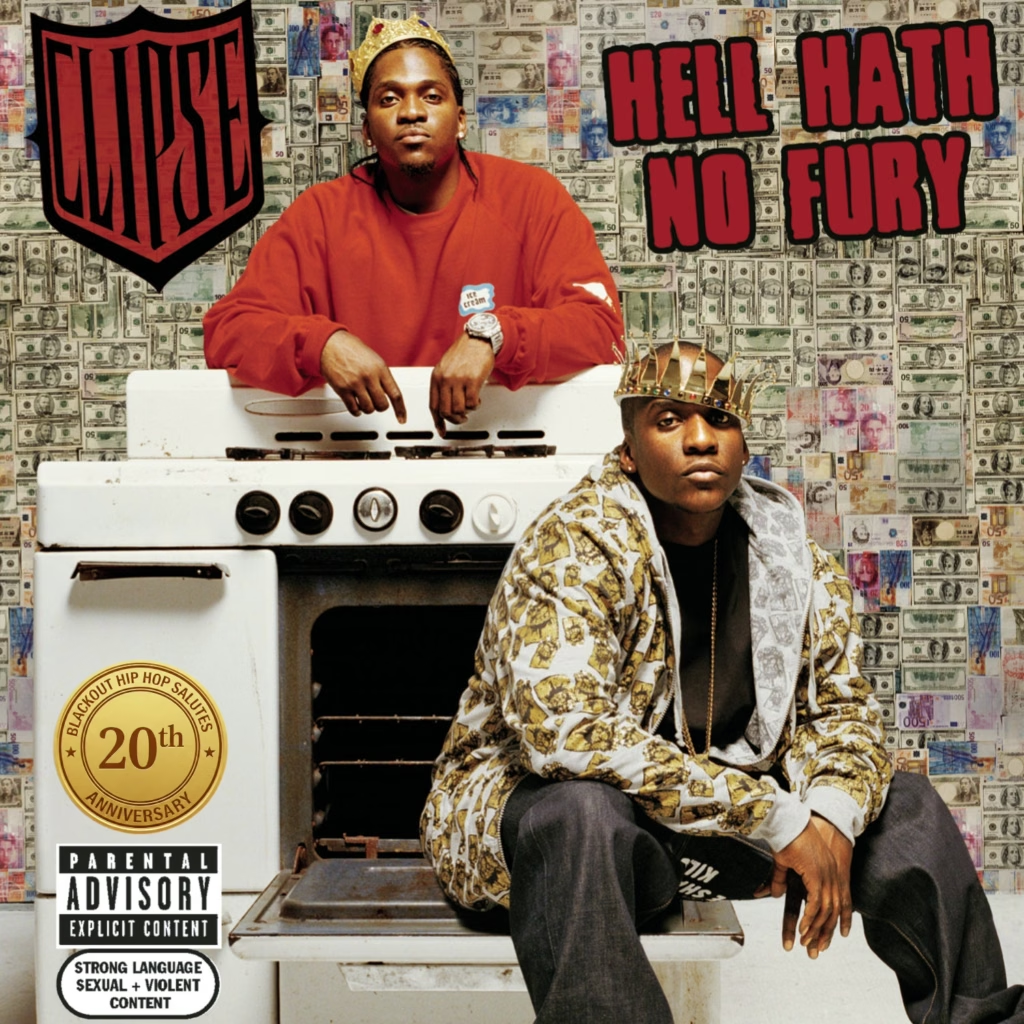
On this day, November 28, 2006, Virginia Beach brother duo Clipse—comprising Pusha T (Terrence Thornton) and Malice (Gene Thornton, later known as No Malice)—released their long-delayed sophomore studio album, Hell Hath No Fury, via Re-Up Gang, Star Trak, Arista, and Zomba. Twenty years later, this lean 12-track, 48-minute statement stands as one of the sharpest, coldest, and most influential hip-hop records of the 2000s. Where their 2002 debut Lord Willin’ rode sunny Neptunes bounce to mainstream crossover success, Hell Hath No Fury was forged out of years of label purgatory, bitter frustration, and a fierce determination to elevate street storytelling into stark, minimalist art.
Label Purgatory at Jive Records and Fury Turned Into Bars
To understand the icy venom coursing through every bar on this album, you have to trace the corporate limbo Clipse endured between 2003 and 2006. Recording began in late 2003 at Hovercraft Studios in Virginia Beach, only to grind to a halt in 2004 when Arista Records was folded into sister label Jive Records during the Sony Music–BMG merger. While Star Trak Entertainment migrated to Interscope, contractual red tape trapped Clipse at Jive, which shelved and delayed the LP repeatedly throughout 2004 and 2005. Only after the duo sued Jive for a release and reached a settlement in May 2006 was the November 28 street date finally locked in.
During those agonizing years on the sidelines, Pusha T and Malice refused to go quiet. Linking up with Philadelphia MCs Ab-Liva and Sandman as the Re-Up Gang, they kept street anticipation at a fever pitch with the acclaimed We Got It 4 Cheap mixtape series, sharpening their pen game to a razor’s edge. As Pusha T told AllHipHop in mid-2006, the carefree headspace of Lord Willin’ was long gone—they were angry, hungry, and ready to channel that resentment into their hardest work yet. That mindset explodes immediately on opener “We Got It for Cheap (Intro)”—where icy delivery and razor-sharp bars establish a relentless tone—and carries straight into the ruthless “Momma I’m So Sorry”, an unvarnished account of street survival with zero apologies.
The Neptunes’ Minimalist Sonic Laboratory
Production across the entire tracklist is officially credited to The Neptunes (Pharrell Williams and Chad Hugo), though Pusha T noted in 2025 interviews that Pharrell handled the beats on this album single-handedly. Regardless of studio credits, the soundscape felt utterly alien compared to anything else on rap radio in 2006. Stripping away glossy soul loops and club synths, the beats rely on stark, eerie minimalism: metallic snares, sinister accordions, plucked harps, distorted cowbells, and cavernous pockets of silence that give every syllable room to cut.
Lead single “Mr. Me Too” (released May 23, 2006, peaking at number 65 on Billboard’s Hot R&B/Hip-Hop Songs chart), featuring Pharrell Williams, captures that icy swagger while Pusha openly apologizes to fans and calls out Jive executives for stalling their momentum. Follow-up single “Wamp Wamp (What It Do)” (issued October 31, 2006) pairs steel-pan drums with Houston heavyweight Slim Thug, delivering one of the most hypnotic and unconventional club tracks of the decade.
Street Poetry: “Keys Open Doors”, “Ride Around Shining”, and Guests
Thematically, Hell Hath No Fury lives squarely within the coke-rap tradition Clipse helped define, yet what separates it from generic street records is its surgical precision and lack of cartoonish glamorization. On “Ride Around Shining” (featuring Ab-Liva), tense harp plucks underscore a cold portrait of excess and paranoia, while “Dirty Money” and “Hello New World” examine the psychological toll of living outside the law. That stripped-down tension peaks on “Keys Open Doors”, where squealing synths and thudding drums frame some of the sharpest, most quotable verses either Thornton brother ever committed to tape.
The closing stretch never lets up: “Ain’t Cha” brings the full Re-Up Gang posse together, while the blown-out bass monster “Trill” earned the number six spot on Pitchfork’s Top 100 Tracks of 2006. After “Chinese New Year” alongside Roscoe P. Coldchain, the album closes on the haunting “Nightmares” featuring neo-soul vocalist Bilal and Pharrell—an unsparing meditation on anxiety, guilt, and the heavy price of street survival. Behind the scenes, engineer Andrew Coleman and mastering veteran Chris Gehringer ensured every snare hit with surgical clarity, while Jonathan Mannion shot the iconic kitchen-stove cover art.
Critical Acclaim, Chart Run, and 20-Year Legacy
Debuting at number 14 on the US Billboard 200 and number two on the Top R&B/Hip-Hop Albums chart with roughly 80,000 copies sold in its first week (and over 205,000 in the US by 2009), Hell Hath No Fury found its loudest triumph in critical consensus. Holding a Metacritic score of 89 out of 100, it became just the sixth album in XXL magazine history to earn a perfect “XXL” rating. Five-star raves poured in from AllMusic, The Guardian, and Observer Music Monthly, alongside a 9.1/10 from Pitchfork (who later ranked it eighth on their list of the 100 Best Rap Albums of All Time) and an A from Entertainment Weekly. Year-end accolades followed swiftly: Prefix named it the best album of 2006, Blender placed it at number six, Spin ranked it ninth, Complex later placed it at number 20 among the best albums of the 2000s, and The Guardian included it on its list of the 100 best albums of the 21st century.
Following 2009’s Til the Casket Drops, the brothers pursued distinct solo paths before reuniting for their acclaimed 2025 comeback album Let God Sort Em Out. Beyond the tight 12-track sequence, the era also left behind notable unreleased cuts like “Stuntin’ Y’all” and “Double Down” featuring Vybz Kartel, while Britain’s The Sunday Times ranked the LP fourth among the best pop and rock records of 2007, praising its claustrophobic edge and sonic inventiveness. Two decades on, Hell Hath No Fury remains a masterclass in zero-filler sequencing and cold-blooded focus—proof that Clipse and The Neptunes formed one of the most lethal creative partnerships in hip-hop history, leaving an unmistakable blueprint for modern street rap.