40 Years of L.A. Dream Team’s Kings of the West Coast
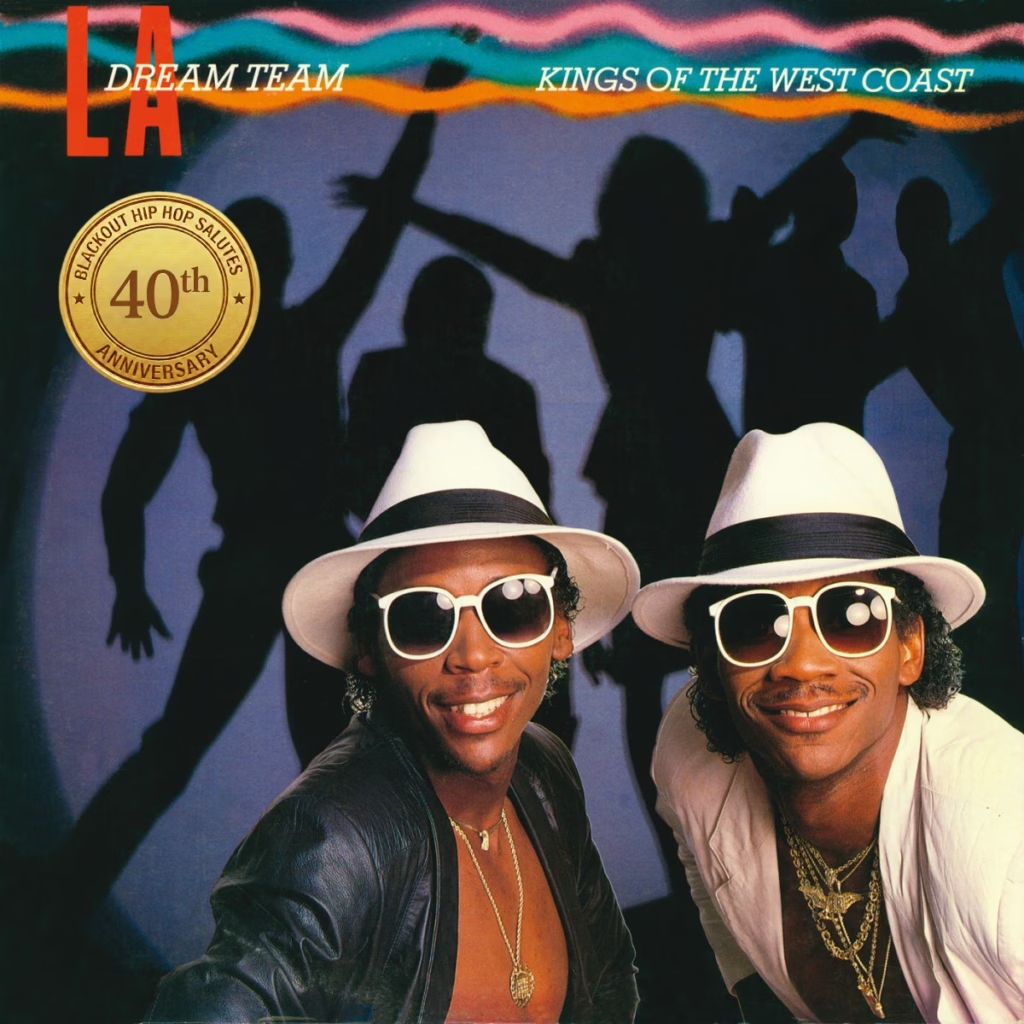
Today marks exactly forty years since music stores first stocked a vinyl record carrying a bold, unapologetic title: Kings of the West Coast. On September 2, 1986, MCA Records officially dropped the debut full-length effort from the duo known as the L.A. Dream Team. For seasoned hip hop heads who followed the culture before gangsta rap dominated every corner of the conversation, this date represents the moment West Coast electro-hop hit its undeniable commercial stride.
The album didn’t drop in a vacuum. It was propelled by months of relentless momentum across Los Angeles street corners, packed roller rinks full of poppers and lockers, and regular rotation on the legendary 1580 AM KDAY. While East Coast purists at the time frequently brushed off California’s output as overly speedy, dance-heavy, or derivative of European electronic tracks, Kings of the West Coast served as a necessary sonic stepping stone. It captured a distinctive era when the Roland TR-808 set the tempo for the pavement and West Coast hip hop was busy carving out its own lane.
From Macola Trunk Hustle to the Major League
The story of the L.A. Dream Team comes down to two contrasting personalities who knew how to tap into the local pulse. Rudy Pardee, an ambitious transplant from Cleveland, brought business acumen and administrative focus to the table. On the other side stood Chris Wilson, widely known in the streets as Snake Puppy, whose roots were embedded in the DJ culture of Watts and South Central. Wilson was plugged into the underground; he was the one who famously introduced a young Greg Broussard, aka The Egyptian Lover, to Rodger Clayton of Uncle Jamm’s Army, setting off a chain reaction across the Southern California electro landscape.
By 1985, Pardee and Wilson launched Dream Team Records. Independent distribution in Los Angeles back then ran through the mythical Macola Record Co. plant on Santa Monica Boulevard. Macola’s model was straightforward: you paid for pressing, picked up your wax, and moved records out of your trunk straight to mom-and-pop shops and local DJs. Early 12-inch pressings of cuts like “The Dream Team Is in the House” and “Rockberry Jam” moved tens of thousands of units purely off grassroots hype.
Once KDAY program director Greg Mack added the tracks into regular rotation during his influential Mack Attack shifts, area clubs and dance parties reached a fever pitch. A&R scouts at MCA Records quickly realized the energy couldn’t be ignored. The label signed the duo, bringing them into major-label facilities to flesh out a full LP. Digital DSP tags pointing to Geffen Records nowadays simply reflect corporate consolidation; in 2003, Universal Music Group folded the defunct MCA catalog into Geffen. At its core, Kings of the West Coast remains an authentic MCA-era document driven by independent street momentum.
Sonic Architecture: 808 Programming, Vocoders, and Hollywood detours
Musically, the eight tracks on Kings of the West Coast capture an essential transition point between early party-rap traditions and synthesizer-heavy funk. Snake Puppy handled the drum programming, credited on the sleeve for providing “devastating high velocity beats”. His sequences pushed the Roland TR-808 past 120 BPM, catering directly to breakdancers and massive mobile sound systems that required heavy sub-bass response and sharp snares.
Core cuts like the title track, “The Dream Team Is in the House,” and “Nursery Rhymes” relied on an infectious formula: call-and-response chants, robotic vocoder filters, and lively synth lines performed by Michael Perison and Richard Anthony, better known as The Real Richie Rich. Lyrically, the material was far from complex; Pardee and Wilson traded lighthearted, nursery-rhyme cadences designed to rock a crowded venue rather than provide deep street commentary.
The oddball selection on the tracklist is undoubtedly “Hollywood Boulevard”. Composed and produced by seasoned television/film scorer Steve Dorff, featuring instrumentation from jazz-fusion keyboardist Jeff Lorber and backing vocals by The Waters, the song was cut specifically for the soundtrack of Sondra Locke’s film Ratboy. While it felt noticeably polished compared to the raw drum-machine bounce of the surrounding tracks, it showed how major labels were testing ways to market West Coast rap within mainstream Hollywood entertainment.
Chart Numbers and the East-West Divide
Looking at the numbers objectively, the commercial performance of the record was significant for hip hop in 1986. Kings of the West Coast peaked at No. 138 on the Billboard 200, spending seven weeks on the national chart. It made an even stronger impact on the Billboard Top Black Albums chart, climbing to an impressive No. 17 peak and confirming solid retail demand in urban centers across the country.
On the singles front, “The Dream Team Is in the House” reached No. 24 on the Hot Dance/Disco Club Play chart, while “Nursery Rhymes” climbed to No. 50 on the Hot Black Singles survey.
Yet critical praise was hard to come by, particularly back East. While California teenagers were wearing down their sneakers to these records, New York publications routinely dismissed the scene as superficial party fodder. Years later, AllMusic critic Ron Wynn famously wrote that Pardee and Wilson never became kings or princes, settling instead for “court jester status” with only one mildly entertaining track. That kind of retrospective review misses the cultural function of the record. L.A. Dream Team never set out to compete with the lyricism of Rakim or the political edge of Public Enemy; their domain was the dance floor at Skateland U.S.A. and the energy inside the Los Angeles Sports Arena.
The Technical Legacy: Paving the Way for G-Funk
The group’s commercial visibility faded quickly as the culture evolved toward harder realism with the rise of Ice-T and N.W.A. Yet the personnel who engineered and arranged Kings of the West Coast went on to leave a massive imprint on 1990s hip hop history.
Co-producers and engineers Courtney Branch and Tracy Kendrick established Total Trak Productions shortly after their work on this record. A few years later, the duo served as executive producers and engineers on DJ Quik’s 1991 platinum debut, Quik Is the Name, shaping the clean, laid-back funk that came to define Compton’s signature sound. The Real Richie Rich, who laid down keys on “Nursery Rhymes,” went on to program the iconic synthesizers on DJ Quik‘s timeless anthem “Tonite“.
Furthermore, Dream Team Records initially released the first single from J.J. Fad before Dr. Dre took the group under Ruthless Records and produced their smash “Supersonic“. The bridge between mid-80s electro-hop and the early-90s G-funk explosion is much more interconnected than casual listeners realize.
The 40-Year Verdict
Spinning Kings of the West Coast four decades later makes one thing evident: it is an unapologetic product of 1986. Lyrically innocent, rooted in rapid synthesizer arpeggios, and unconcerned with grand philosophical statements, it is not a record designed to deliver complex poetic breakdowns.
Yet dismissing it would mean overlooking an essential piece of West Coast hip hop heritage. Kings of the West Coast captures an era of pure community energy, youth culture, and high-voltage sound systems. Following Rudy Pardee’s tragic passing in a 1998 scuba-diving accident, any future reunion was permanently silenced, leaving the music to stand strictly on its original merits. Forty years down the line, the boom of the 808 on tracks like “Rockberry Jam” still speaks volumes about a crew that dared to claim the throne when California was just learning to find its voice.