Lupe Fiasco – Food & Liquor: 20 Years of a Classic Debut
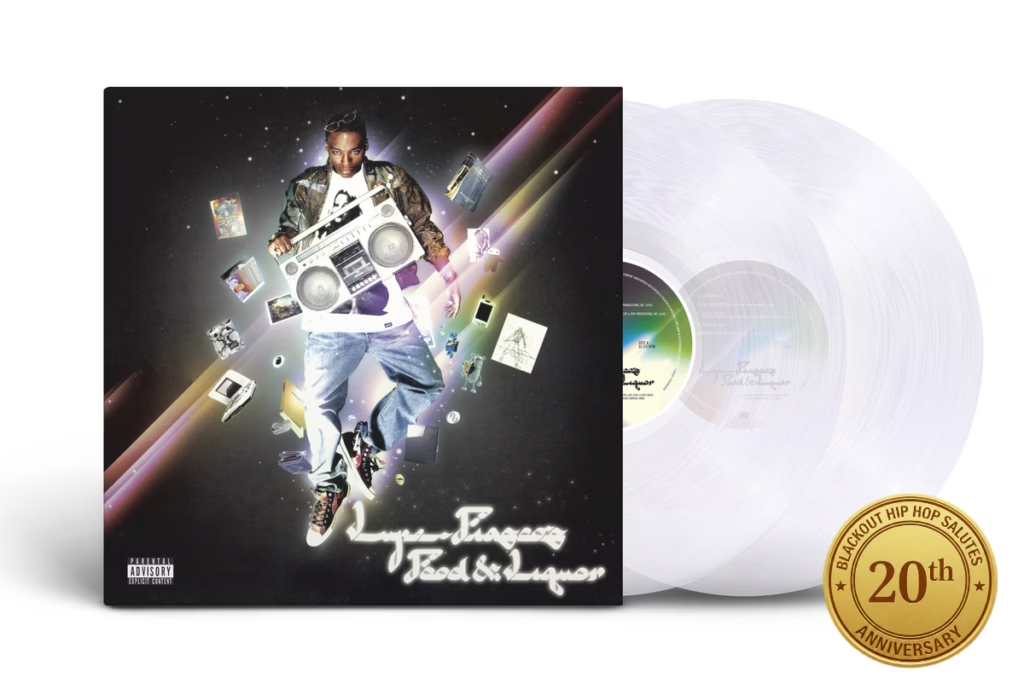
Today marks exactly twenty years since September 19, 2006, when Chicago emcee Lupe Fiasco released his landmark debut studio album, Lupe Fiasco’s Food & Liquor, through his own imprint 1st & 15th Entertainment and Atlantic Records. Arriving without relying on mainstream formula or radio pandering, the record proved to be a pivotal moment for mid-2000s hip hop. It bridged the gap between underground mixtape lyricism and major-label execution, offering a fresh narrative voice that reshaped what an emcee could represent on a wide stage.
The 2006 Landscape: Where Hip Hop Was At
To truly grasp the significance of Food & Liquor, one has to revisit the rap landscape of 2006. The culture was undergoing a massive regional transformation. The American South had a tight grip on the mainstream airwaves; snap music was birthing massive dance crazes courtesy of groups like Dem Franchize Boyz, while Young Jeezy and T.I. were defining the trap sound with booming 808s and raw street reports. Meanwhile in Miami, Rick Ross was establishing his cinematic brand of luxury drug-dealer rap.
Within that commercial climate, the lane for an introspective kid from the West Side of Chicago—rocking Cartier glasses, riding a skateboard, referencing anime and comic books, all while reciting Quranic verses and breaking down American foreign policy—seemed practically non-existent.
Lupe had already earned a fierce underground buzz through his revered Fahrenheit 1/15 mixtape run, where his breathless flows and intricate multi-syllabic rhyme schemes turned heads across the internet. Mainstream listeners caught their first real dose of his talent when he delivered a show-stealing guest verse on Kanye West’s 2005 hit single “Touch the Sky“, a performance so potent it led Jay-Z to co-sign the young lyricist and offer to executive produce his upcoming debut.
The Infamous Leak and Jay-Z’s Co-Sign
Lupe’s path to commercial shelves was filled with institutional hurdles. He had originally signed to Arista Records, but after music executive L.A. Reid was fired, Lupe found himself without label backing. His manager, Charles “Chilly” Patton, navigated him to Atlantic Records, setting up a proper infrastructure where Lupe retained creative control via 1st & 15th. Jay-Z stepped in as an executive producer alongside Patton and Lupe himself. The album was initially slated for an April 2006 release.
Then disaster struck: in April 2006, the entire unmastered work-in-progress version of the album leaked onto peer-to-peer sharing networks and hip-hop message boards. Atlantic was forced to shelve the scheduled rollout. But instead of ending his career, the leak sparked organic praise. Critical outlets like Rolling Stone and fellow artists like Pharrell Williams and Kanye West openly hailed Lupe as the potential “savior of hip hop”.
Refusing to simply repackage the leaked audio, Lupe went back into the studio to revamp the tracklist. He resolved sample clearance issues, discarded tracks that no longer fit, and wrote new records—including the soulful banger “Pressure“, where he traded verses with Jay-Z and directly addressed the psychological weight of the leak and record label expectations.
The Philosophy of Food & Liquor
The title of the album was rooted in the neighborhood corner grocery stores scattered across urban Chicago. Lupe elevated this local staple into an overarching philosophical concept: “Food” represents sustenance, innocence, moral virtue, and basic necessities, while “Liquor” stands for vices, decay, violence, and moral compromises. The stores house both elements side by side, reflecting how good and evil operate simultaneously in human behavior and inner-city reality.
The visual presentation of the album mirrored this worldview. Designed by Chuck Anderson (No Pattern) and inspired by Katsuhiro Otomo’s manga cover for Domu, the artwork showed Lupe floating in zero gravity surrounded by everyday items that shaped his identity: a Quran gifted by his father, dog tags, a handheld Nintendo Game Boy Advance, a Banksy postcard, an early touchscreen PDA, and a hard copy of his Fahrenheit 1/15 mixtape. It was a visual celebration of skate, nerd, and street aesthetics coexisting naturally.
Sonic Architecture: Soul Samples and Live Textures
Sonically, Food & Liquor pushed back against the disposable synth presets of the era. In-house Chicago producer Soundtrakk served as the musical spine, crafting warm, sample-based orchestrations that gave Lupe room to breathe. Fellow collaborator David “Prolyfic” Ewing Jr. introduced darker, syncopated rhythms on tracks like “American Terrorist” and “Pressure“.
External heavyweights added variety without disrupting the album’s cohesion. The Neptunes provided quirky, stripped-down funk on “I Gotcha“, Kanye West flipped a Dexter Wansel sample for the dramatic street parable “The Cool“, and Linkin Park’s Mike Shinoda supplied a crunchy alt-rock instrumental on “The Instrumental“. Atlantic’s Craig Kallman, alongside English electronic duo I Monster, shaped the dreamy backdrop for “Daydreamin‘”.
Standout Cuts: From Kickflips to Giant Robots
The album’s lead single, “Kick, Push“, released in April 2006, served as an anthem for misfits. Built on an instrumental sample of Celeste Legaspi’s “Magtaksil Man Ikaw”, the track chronicled the life journey of a young skater. Despite early skepticism from skate purists, the song caught fire, earning video spins and placements in key video games like Tony Hawk’s Downhill Jam.
The third single, “Daydreamin'” featuring neo-soul singer Jill Scott, was an imaginative critique of radio music. Over a lush, cinematic beat, Lupe rhymed from inside the cockpit of a giant robot roaming the city, calling out the industry’s push to make street violence and materialism look trendy. The record earned Lupe his first Grammy Award for Best Urban/Alternative Performance.
Other cuts carried significant emotional weight. On “American Terrorist”, Lupe questioned political narratives and post-9/11 hysteria, while “Hurt Me Soul” tackled the difficult paradox of loving hip-hop music while hating its recurrent misogyny and self-destructive messaging. “The Cool” introduced the fictional character Michael Young History, laying the foundation for his 2007 sophomore album of the same name.
Sales, Grammys, and the Real Numbers
Food & Liquor was never designed to be an overnight commercial smash, but its trajectory was remarkably steady. The album debuted at number eight on the US Billboard 200 chart (initially misreported as number 12 due to incomplete SoundScan reports), scanning 81,000 copies in its first week. By early 2008, it had sold over 325,000 physical units in the US. Fifteen years after its debut, on September 22, 2021, the album was officially certified Gold by the RIAA.
Critical reception was universally glowing, holding an 83 aggregate score on Metacritic. At the 49th Annual Grammy Awards, Lupe scored three nominations: Best Rap Album, Best Rap Solo Performance, and Best Rap Song (both for “Kick, Push”). He followed that up at the 50th Annual Grammy Awards by winning Best Urban/Alternative Performance for “Daydreamin'”.
Two Decades Later: A Lasting Blueprint
Looking back at Food & Liquor after twenty years, its legacy remains undisputed. The record served as an indispensable stylistic bridge into rap’s “Blog Era”. By proving that an emcee could be socially conscious, technically intricate, and commercially viable without adopting a hyper-aggressive street persona, Lupe cleared the path for the likes of Kendrick Lamar, J. Cole, Tyler, the Creator, and Childish Gambino.
Two decades later, Food & Liquor is remembered not as a relic of nostalgia, but as a clinic in classic album construction and timeless hip-hop lyricism.