Ice Cube: 35 Years of the Masterpiece Death Certificate
Processed By eBay with ImageMagick, z1.1.0. ||B2
On this day, October 29, 1991, West Coast hip-hop titan Ice Cube released his second solo studio album, Death Certificate, through Priority Records. Exactly thirty-five years later, this monumental work stands not only as the undisputed creative pinnacle of O’Shea Jackson’s legendary career, but also as one of the most explosive, politically daring, and prophetic masterworks in the history of hip-hop culture. Arriving in an era when Los Angeles was a volatile powder keg of racial friction and institutional police harassment—just six months before the city erupted in the historic 1992 civil rebellions—the album offered a fearless post-mortem of systemic inequality, economic neglect, and internal community struggle.
Conceptual Framework: The Death Side and The Life Side
Following his landmark 1990 solo debut, AmeriKKKa’s Most Wanted, recorded in New York alongside Public Enemy’s legendary production unit The Bomb Squad, Ice Cube returned to the West Coast determined to construct an even more ambitious thematic statement. The result was a brilliant twenty-track conceptual record strictly divided into two distinct ideological halves. The first half, dubbed The Death Side, opened with the sobering thesis: “a morbid vision of where we are today.” The second half, designated as The Life Side, offered “a vision of where we need to go.”
Across The Death Side, Ice Cube delivers an unvarnished chronicle of ghetto survival, drug addiction, and urban despair. Following the solemn organ chords of „The Funeral”, the record ignites with the sheer ferocity of „The Wrong Nigga to Fuck Wit”. On the cinematic narrative cut „My Summer Vacation”, Cube details how South Central hustlers fled the aggressive sweeps of LAPD’s Operation Hammer to establish crack distribution networks in St. Louis. He then confronts risky lifestyle choices and youth recklessness on tracks like „Givin’ Up the Nappy Dug Out” and „Look Who’s Burnin’”.
The emotional apex of the side arrives on the harrowing „Alive on Arrival”, which tells the story of a young man caught in a drive-by shooting who slowly bleeds to death in the underfunded emergency room of Martin Luther King Jr. Hospital in Watts, while hospital administrators and police officers prioritize paperwork over immediate trauma care. Immediately following, „A Bird in the Hand” dissects the economic trap of a young father with a high school diploma forced to choose between the dead-end wages of fast food and the drug trade to feed his child. The side closes with „Man’s Best Friend”, declaring a shotgun to be a far more reliable protector than a guard dog, before the flatlining heart monitor on „Death” signals the symbolic demise of that self-destructive era.
P-Funk Soundscapes and Street Level Production
The sonic architecture of Death Certificate was crafted by Cube alongside his cousin Sir Jinx and production unit The Boogiemen, consisting of DJ Pooh, Bobcat, and Rashad Coes. Pivoting away from the dense, noisy East Coast sample walls of his debut, the production team developed an authentic West Coast sound built on deep funk grooves. By sampling, slowing down, and reinterpreting the catalogs of Parliament, Funkadelic, Zapp, Ohio Players, Sly & the Family Stone, and Kool & the Gang, they effectively laid the musical blueprints for what would soon dominate the airwaves as G-funk.
The defining musical statement of this era is the album’s lead single, the iconic anthem „Steady Mobbin’”. Riding a rolling funk bassline and an undeniable street bounce, the track captures a humid, tense day cruising through South Central, as Cube balances menacing street credibility with infectious narrative charisma.
The album’s sound is further enriched by intricate audio collage techniques, weaving together news reports, radio talk shows, and neighborhood dialogue to create an audio documentary experience. Every track flows seamlessly into the next, maintaining a palpable sense of danger and urgency that mirrors the streets of early-nineties California.
Socio-Political Fire, Street Unity, and National Controversy
The transition into The Life Side begins with „The Birth”, featuring a speech by Nation of Islam minister Khalid Abdul Muhammad, shifting the focus toward self-reliance, moral discipline, and intellectual resistance. On „I Wanna Kill Sam”, Cube offers an incisive political allegory examining the historical exploitation of Black soldiers conscripted to fight foreign wars for an empire that refused them basic humanity at home.
A crucial moment of street solidarity occurs on „Color Blind”, where Cube brings together West Coast luminaries including WC, King T, J-Dee, Kam, and Threat to demand an immediate truce between rival Crips and Bloods sets. This message of community loyalty is reinforced on the second single, „True to the Game”, which critiques Black professionals and artists who abandon their neighborhoods the moment they achieve financial success.
Naturally, such an unfiltered sociopolitical perspective sparked intense national controversy. The inflammatory cut „Black Korea” ignited fierce outrage and boycott threats from Korean-American business organizations, written in the aftermath of the tragic shooting of fifteen-year-old Latasha Harlins by a shop owner. Furthermore, biting critiques on „Horny Lil’ Devil” and „Us” forced mainstream institutions to confront the explosive anger brewing within inner-city neighborhoods. Yet the musical shockwave that permanently altered rap history was the closing track, „No Vaseline”. Responding to disses on N.W.A’s *Niggaz4Life*, Ice Cube unleashed a legendary, one-man assault that completely dismantled his former crew—targeting Dr. Dre, Eazy-E, MC Ren, DJ Yella, and manager Jerry Heller—setting the definitive gold standard for battle rap.
Critical Acclaim, Commercial Impact, and Enduring Legacy
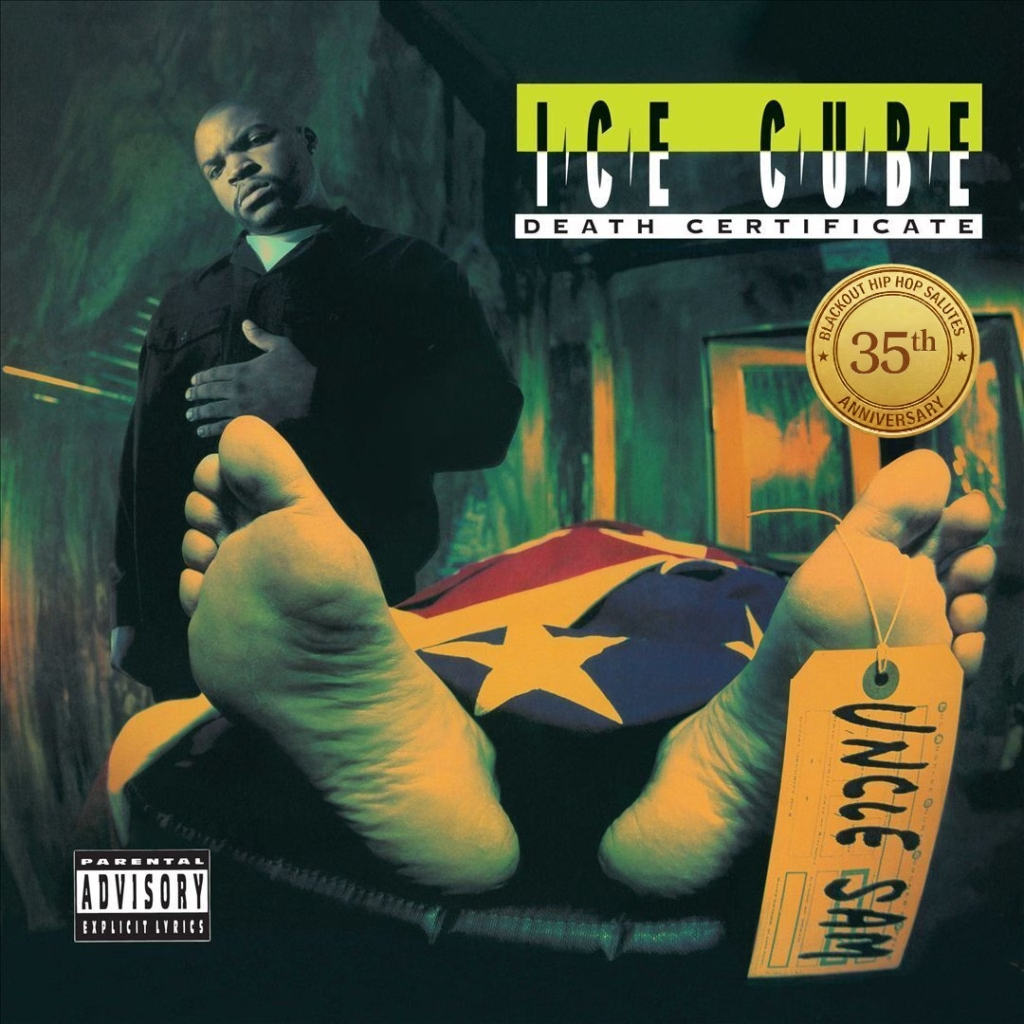
Despite heavy corporate resistance, radio boycotts, and regional retail bans—including retail chains in Oregon pulling displays over the provocative album cover depicting Uncle Sam in a morgue—Death Certificate was an enormous commercial triumph. The album entered the Billboard 200 at number two (held out of the top spot only by Garth Brooks) and ruled the Top R&B/Hip-Hop Albums chart at number one, moving over one million copies within seven weeks to achieve RIAA Platinum certification by December 1991.
Critics were stunned by the sheer power, narrative cohesion, and thematic bravery of the record. The Source magazine retroactively bestowed its highest rating of Five Mics upon the LP, and leading publications worldwide routinely cite it as one of the greatest rap albums ever conceived. Thirty-five years after its release, Death Certificate remains a monumental testament to revolutionary artistic conviction that firmly solidified Ice Cube as an immortal architect of hip-hop culture.