15 Years of Death of an Indie Label Documentary
The Rise and Fall of Reel Life Productions
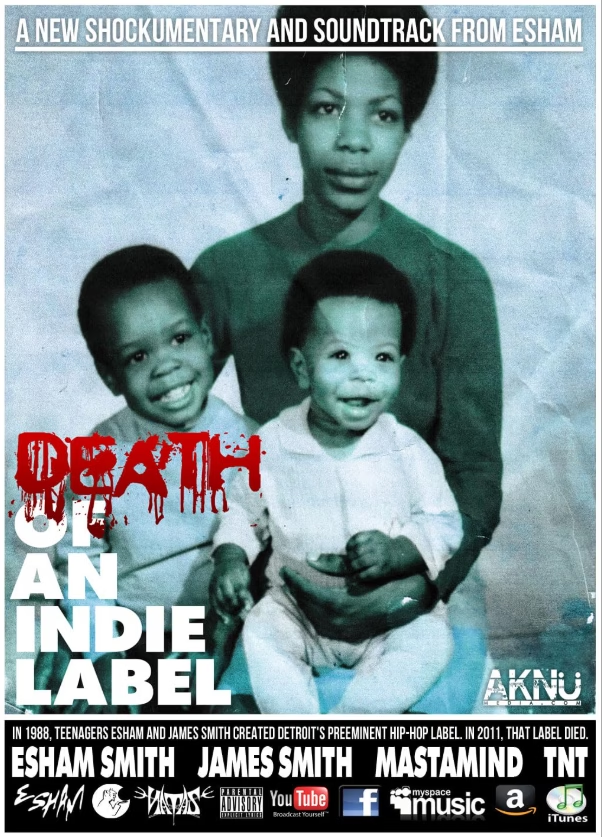
Fifteen years ago today, on July 27, 2011, Detroit hip-hop pioneer Esham (Rashaam Attica Smith) uploaded a documentary titled Death of an Indie Label to Gothom Inc.’s official YouTube channel. There was no major press push, no red carpet premiere, and no corporate backing. It was simply a raw, uncompromising look at the history, golden era, and eventual downfall of Reel Life Productions (RLP)—the label he co-founded with his older brother, James H. Smith. Today, a decade and a half later, the film remains one of the most honest depictions of independent hip-hop hustle ever committed to video.
Underground Roots and the Birth of “Acid Rap”
To understand the documentary, one has to go back to the late 1980s. Founded between 1988 and 1990 by teenagers Esham and James Smith, Reel Life Productions emerged at a time when Detroit lacked an established rap scene or music industry infrastructure. While many local acts attempted to emulate East Coast or West Coast styles, James recognized a distinct sound in his younger brother’s dark, boundary-pushing lyrics and musical talent.
In 1989, at just 16 years old, Esham recorded his debut album, Boomin’ Words from Hell, in a single day. Driven by vivid depictions of Detroit’s crack epidemic, street paranoia, and heavy rock sample influences, Esham coined his style “acid rap“. Soon after, Esham linked up with high school classmate Mastamind and friend T-N-T to form Natas, releasing their seminal 1992 album Life After Death. Operating completely on a DIY basis, Reel Life Productions bypassed mainstream radio, selling hundreds of thousands of tapes and CDs directly out of car trunks and local shops. This movement laid the groundwork for the Midwest horrorcore subgenre and heavily influenced future Detroit icons like Insane Clown Posse, Kid Rock, and Eminem.
Industry Struggles and Personal Tragedy
Building an independent empire from the ground up came with severe obstacles. Reel Life Productions faced heavy public backlash following a national controversy where a 17-year-old fan tragically took his own life playing Russian roulette while listening to Life After Death. While the notoriety solidified their underground status, internal hardship proved far more damaging.
In 1994, label CEO James H. Smith was incarcerated, dealing a major blow to the company’s daily operations. Following his release, James was diagnosed with schizophrenia. With limited mental health resources and mounting financial pressures, the label struggled to maintain its footprint. By the late 1990s, RLP filed for bankruptcy and rebranded as Gothom Records, seeking distribution deals through label outlets like TVT Records.
Esham later signed with Psychopathic Records in 2002, releasing notable charting projects such as Repentance (2003) and A-1 Yola (2005). However, creative differences and financial disputes eventually led to an abrupt departure and a public feud.
The Documentary and Accompanying Soundtrack
Death of an Indie Label was born out of a desire to document RLP’s history before it faded from the culture’s memory. Originally intended as a bonus feature for the deluxe edition of Esham’s 2011 album DMT Sessions, Esham ultimately opted to release the film for free on YouTube.
The film holds nothing back. Featuring archival footage and candid commentary from Esham, James Smith, and Mastamind, it offers an unflinching look at their reality. One of the most sober moments of the documentary focuses on James Smith’s deteriorating mental condition, his eviction from his apartment, and his eventual move in with Esham. In addition to the personal family narrative, the film chronicles Esham’s frustrations with corporate label politics and his tenure at Psychopathic Records. Detroit publication Metro Times fittingly highlighted the film as “compelling viewing” for its stark honesty.
To complement the film, Esham released an official 20-track mixtape soundtrack under the same title on September 1, 2011. Packed with classic Esham production, the project featured guest appearances from Detroit underground regulars Seven the General and Poe Whosaine. Cuts like “House 4 Rent“, “Serious Business“, and the title track “Death Of An Indie Label” echoed the documentary’s core themes of financial turmoil, independence, and street survival.
The Legacy 15 Years Later
Fifteen years after its release, Death of an Indie Label remains an essential piece of hip-hop history. It captures a pivotal moment of industry transition—bridging the gap between the physical trunk-selling era of the 1990s and the digital streaming age.
While Reel Life Productions may no longer operate as it once did, the blueprint created by Esham and James Smith shaped the sound of Detroit rap for generations. Death of an Indie Label isn’t a story of corporate triumph, but rather a realistic testament to the true cost of artistic independence.