Looking Back at German Hip-Hop’s Most Sample-Heavy Masterpiece
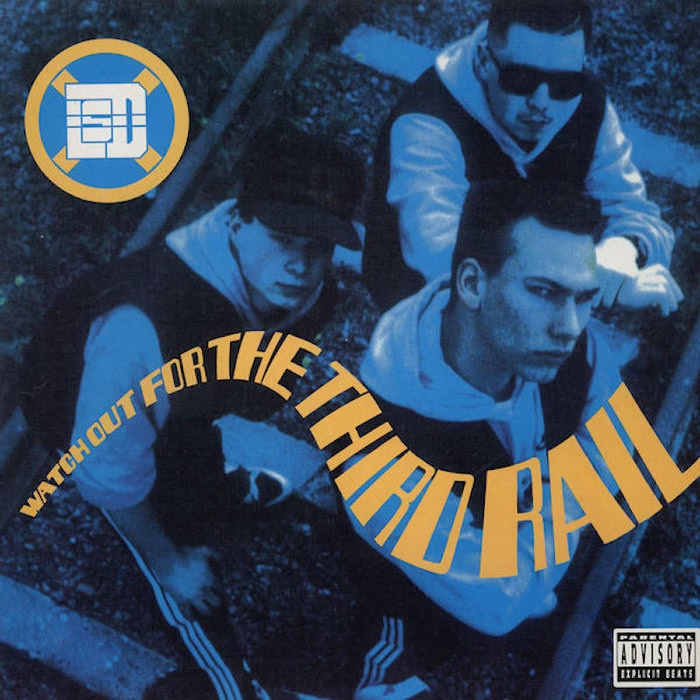
LSD – Watch Out For The Third Rail
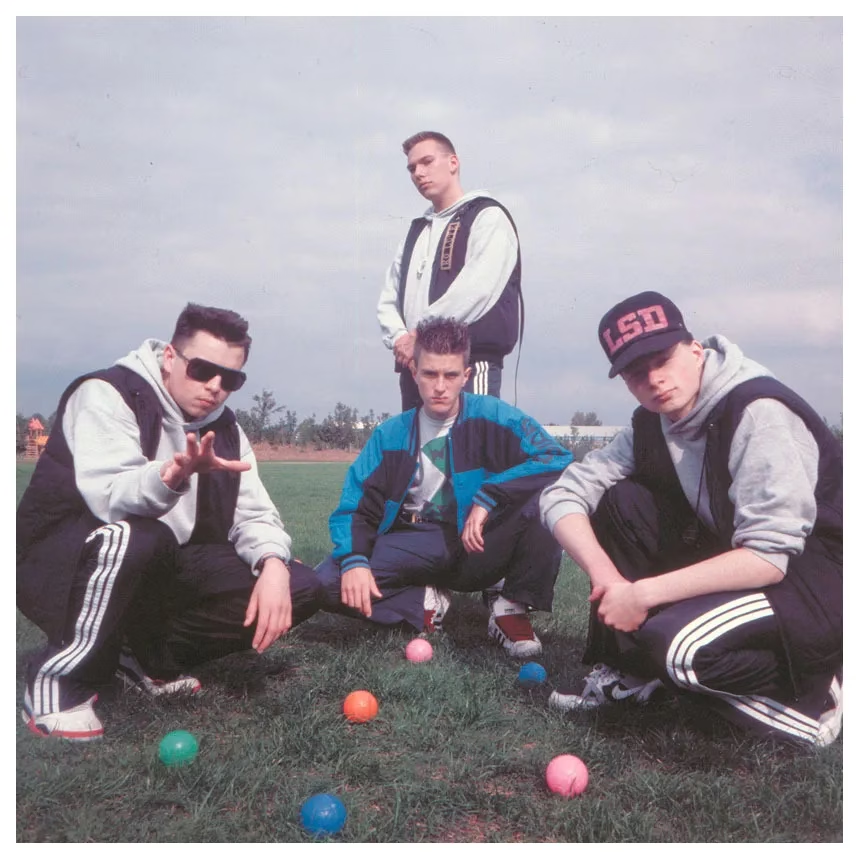
Thirty-five years ago, Germany’s first officially label-released hip-hop album dropped: LSD’s “Watch Out For The Third Rail”. Using basic studio gear and over 1,500 samples, four hip-hop pioneers from the North Rhine-Westphalian province tamed a beast that put even Public Enemy, De La Soul, and the Beastie Boys in the shade. Three decades later, Rick Ski, Ko Lute, and Defcon talk with Andreas Purzer about their longplayer, which retains cult status today far beyond old-school circles.
How did four teenagers from a rural province in Germany even come into contact with hip-hop in the early eighties?
Rick Ski: Mainly through television. Documentaries about New York City, its social flashpoints, and cultural scene aired from time to time. Personally, I was especially fascinated by the documentary “Breakout – Tanz aus dem Ghetto” featuring Mr. Wiggles & Popmaster Fabel, Grandmixer D.ST, and Lil Sput. It was produced by German television in 1982 and aired a year later on numerous regional third-channel networks. Graffiti Wild Style was also a German co-production broadcast on ZDF even before Americans laid eyes on the flick.
There was no internet, no hip-hop magazines, no radio or TV formats. What were your sources of information?
Defcon: For me, record stores were the most important “information medium.” You went in to see what was new on the wall and took a chance on whatever looked interesting and fit your allowance. The Streetsounds Electro series, featuring the most important new releases mixed together on one record, was particularly formative. In the late 80s/early 90s, there was the English Hip Hop Connection magazine, which I subscribed to.
Ko Lute: Every now and then you’d also pick up something in the hip-hop sections of German dancefloor or music magazines like Network Press or Spex.
Defcon: The British allied radio station BFBS broadcasted John Peel and later Tim Westwood’s Capital Rap Show. I recorded the show every Friday on 120-minute cassettes, later combed through them for the good stuff, and dubbed them over.
Rick Ski: I traveled around a lot and absorbed every usable piece of information. Radio tapes by Mr. Magic or Red Alert from New York, for example, were copied over and over and were worth gold. Aside from the brief Bravo breakdance hype, hip-hop in Germany was something very exotic for the majority of people, and only a few dealt with it seriously. The local record store was a popular meeting place to exchange info. Various English dance music magazines like Echoes also repeatedly featured great articles on hip-hop crews, sampling, and so on.
Which eventually inspired you to produce your own tracks.
Ko Lute: For me and Defcon, it started in 1987 with two turntables and a microphone. A year later, we were already recording tracks using a TR-808 and a multitrack machine. At some point we met Future Rock and Rick Ski. From then on, we made another major leap forward production-wise because the two of them already had a Yamaha TX16W sampler.
Rick Ski: Future Rock and I even started back in 1984. As we got more heavily into the music of Grandmaster Flash & The Furious Five, Grandmixer D.ST, and Afrika Bambaataa, we immediately tried to mimic that sound. At first, in the form of relatively complex megamixes created using tape recorders, turntables, self-assembled sampler modules, cheap drum machines, and so on. For instance, we generated our first breakbeat loops not with electronic samplers, but with tape recorders. The inspiration came from New York remixers like Jellybean, Chep Nuñez, and the Latin Rascals.
Sounds like hard pioneer work.
Rick Ski: Absolutely. Today’s luxuries like specialized books, workshops, or online tutorials didn’t exist back then. So we had to figure out a lot of things ourselves through trial and error. For example, I learned various scratch techniques by listening to corresponding parts at different playback speeds, forwards and backwards, and analyzing them that way.
Defcon: Experimenting and trying things out was the name of the game. Splicing cables together instead of using a mixer, cardboard pads instead of slipmats, volume knobs and signal switches on the amplifier instead of crossfaders/toggle switches, live backspinning over beats from the TR-808, which I bought practically “blind” via a classified ad in a rock magazine. I didn’t know what the thing looked like or how it worked, only that it produced those deep basses. Sample sources gradually revealed themselves through tirelessly listening through vinyl without any genre taboos.
Which allowed you to build up an impressive sample library even as teenagers.
Ko Lute: They came partly from real, partly only presumed rare groove records, as well as Ultimate Breaks & Beats. The funk/soul material came primarily from Future Rock and Rick Ski, while the psychedelic (funk) rock material came mainly from Defcon.
Rick Ski: By the time the album was released, we already had about seven years of intensive digging behind us. It started with our parents’ record collection, where we managed to poach a few breaks like Elvis’s “A Little Less Conversation”. Add to that countless flea markets, record conventions, secondhand shops, and of course numerous bus trips to London where you always struck gold.
Defcon: For me, there were no taboos regarding sample sources. I could fully live out my unbridled curiosity paired with persistence. Metaphorically speaking, I always had a finger on the record button—whether watching TV, listening to the radio, hanging out with friends, shady rocker types from my region, or in musty secondhand cellars. Back then, however, the hip-hop scene was mainly limited to funk/soul/jazz samples, sort of like an unwritten law. I had a rather undogmatic approach to that.

With an estimated 1,500 samples used, “Watch Out For The Third Rail” should have earned you an entry in the Guinness Book of World Records.
Rick Ski: Secretly, our goal with the album was to top every hip-hop group worldwide in terms of sampling and complexity. I think we succeeded. For example, in 2008 at the “Hip Hop Academy” at Wuppertal University, I had the opportunity to explain our production methods at the time to the two Bomb Squad producers, Hank and Keith Shocklee, in a lecture. They were deeply impressed by the sheer multi-layered nature of the songs.
Clearing all those samples must have cost a fortune.
Defcon: No, that wasn’t an issue at the time. We knew that “stealing” in itself was forbidden, but graffiti was illegal too. We never stole cheaply either; meaning we always had the ambition to create something original with samples. Besides, there were De La Soul and Public Enemy—they sampled like crazy too.
Word has it that you didn’t even disclose your sample sources within the group?
Rick Ski: You have to understand that both Defcon and Ko Lute, as well as Future Rock and I, had independently built up sample libraries for years prior to LSD. In the “pre-internet era,” those were worth gold! Back then, you had to work hard for that knowledge over a long period and couldn’t just look it up online. Naturally, you didn’t want to just give that away. Kool Herc, Bambaataa & Co. also used to tape over their record labels back in the day.
Defcon: While this baseline situation was fruitful on a technical level at first, as time went on it made a friendly relationship practically impossible.
Ko Lute: Thus, LSD was essentially more of a productive working community rather than a proper band.
Did this internal rivalry provide extra motivation to create increasingly complex productions?
Rick Ski: No, our goal wasn’t to outdo each other within the group. Rather, we wanted to top all hip-hop groups worldwide when it came to sampling and complexity.
Defcon: Plus, secretly during the production, it probably dawned on all of us that we had to pour all our energy into this project because there wouldn’t be a second LP in this constellation.
What studio equipment did you use to master these immense amounts of data?
Rick Ski: Back then we worked with a Yamaha TX16W sampler, whose memory capacity we expanded from 1.5 MB to the maximum possible 6 MB. Sequencing ran via a Commodore C-64 computer using the “Supertrack” program and a C-Lab MIDI interface. We played in the samples using a Yamaha SHS-10 keytar. To even reach the volume of samples necessary for our songs, we loaded the sampler fully up to three times per track. The sampler tracks were then partially transferred to a 16-track tape machine, and the rest was synchronized with the sequencer.
You pushed the envelope not just with samples. With 27 tracks on that record, you also literally scraped against the physical limits of vinyl records.
Defcon: Our ambition was to exploit the maximum playing time of a record and pack the thing to the brim with our ideas. Sound quality took second place there. Thoughts of pressing albums on double vinyl only occurred to the record industry years later.
Rick Ski: We simply wanted to make the exact complex, sample-overdose album that it turned out to be. We couldn’t compromise or let ourselves be restricted by the technical limitations of certain playback media.
Ko Lute: All our ideas simply had to go out. I also don’t remember us consciously cutting a single track. Without this high track count and the associated variety, the album probably wouldn’t have blown away so many people and achieved today’s cult status.
The virtuose DJ work as one of your trademarks also contributed to that cult status.
Defcon: Cuts always held high compositional value for me and were an integral part of the music. I miss that aspect in today’s productions and appreciate every scratch I get to hear. hip-hop has become mainstream, and original elements like scratches fall through the cracks—just like most people in clubs don’t care whether someone is still spinning records.
Rick Ski: DJing is the musical foundation and simply belongs to a genuine hip-hop production. The fact that the DJ has been increasingly pushed out of the production process has economic reasons above all. The average mainstream rap listener doesn’t understand the virtuosity of many scratch patterns and thus never developed an appreciation for it. Those people likely find scratching disruptive. Furthermore, samples used in scratch parts often have to be legally cleared. That costs money, which most labels prefer to save.
How long did you work on the album?
Ko Lute: For me, from autumn 1989 to summer 1990, partly spanning my high school graduation period. Right after graduation, I moved into Future Rock and Rick Ski’s home studio for weeks, only driving back home to Bonn every few days to write lyrics in peace.
Rick Ski: We worked on it intensively and tightly organized for pretty much a year. Properly with lists and binders. Such a project could never have been pulled off within that timeframe otherwise.
Still, a comparatively long production time. Today, many artists boast about easily recording entire albums in two weeks.
Rick Ski: Measured against the musical and production-related complexity and the way albums were normally created back then, we were actually fast. Back then, you couldn’t just rap vocals in your bedroom; you had to go to a professional studio. The way we worked back then is incomparable to today—if only because there was no internet for everyone and you couldn’t just send files around.
Defcon: Our ambition for the album was the exact opposite of “thrown together on the fly.” There is heart and soul and nerdy meticulousness in there.
In the early 90s, there was still no infrastructure—meaning labels or distributors—that made you think about releasing your own hip-hop album.
Defcon: Even so, it was our big dream from the beginning. Especially since LSD was more of a studio band; you can probably count our live performances on two hands.
Rick Ski: Our vision quite early on was to hear our music pressed on vinyl and played on the radio. In our immediate circle, there were hardly any other groups we could compare ourselves to. So in our minds, people like The 45 King, Ultramagnetic MCs, or The Chosen Ones were role models and competitors all at once.
It eventually led to a deal with Rhythm Attack Productions, a Cologne-based label that otherwise exclusively licensed American productions from Wild Pitch and B-Boy Records for the German market.
Rick Ski: The music on those mentioned labels belonged to our favorites. Therefore, we felt we would be in good hands there. Future Rock set off for Cologne with a demo tape in his luggage to play it for label boss Stephan Meyner. Quite naively, with the attitude: We make good music, you should sign us. Which, to our own surprise, actually worked out.
Rap was still a long way from chart placements in Germany back then. How many copies did the album sell?
Rick Ski: Sales figures played a secondary role for us back then. That might seem naive from today’s perspective, but the pop charts back then were reserved for Stock Aitken Waterman productions, Madonna, or Prince anyway. Hip-hop in Germany was underground music. After the album came out, however, we asked the label for sales figures several times and eventually got some numbers from an inkjet printer along with the note that the advance hadn’t been recouped yet.
Ko Lute: I don’t remember ever receiving a proper statement. Unfortunately, the labels knew that people were simply thrilled to be able to release anything at all. They skillfully exploited that enthusiasm.
Regardless of commercial success, do you feel “Watch Out For The Third Rail” has received sufficient appreciation?
Rick Ski: Due to the excessive focus on German-language rap, that’s not always the case, especially in the media. Respect to everyone who did pioneer work back then, but it’s simply a fact that our album came out before Die Fantastischen Vier or Advanced Chemistry. Whenever the history of German hip-hop is told and our name isn’t mentioned, it leaves a bad taste in the mouth. Pioneering groups like Bionic Force or No Remorze unfortunately face a similar fate in this regard.
What connects you to hip-hop today?
Defcon: I still passionately dig for records and DJ regularly. Furthermore, my book about the early days of German hip-hop in the provinces is up for release.
Rick Ski: Unlike many companions, I never stopped being active in hip-hop. I’ve never been able to understand this “I’m too old for this now” attitude of some people. In my recording studio I produce music, record my own raps or those of other artists, and remain active as a DJ. Just like before. Hip-hop is an important part of my identity to me and not a question of age.
Interview & Text: Andreas Purzer
Foto Credits: Stephan Schuh, Philipp Wohlleben
LSD “Competent” TV performance from 1990:
https://youtu.be/5-uiIJIk2yg?is=66Ub6YkTaO0UND_b
LSD “Competent” Video from 1990:
https://youtu.be/WVywt_0lE2w?is=de3RIzF7pK0BFSMk
LSD “Watch Out For The 3rd Rail” Dope Beat Edition Mix by Rick Ski:
https://youtu.be/ilWPauO_XYo?is=mYz5-5N6AzneRpjS
LSD Bandcamp: