30 Years of “h”: How DJ Honda Bridged the Gap
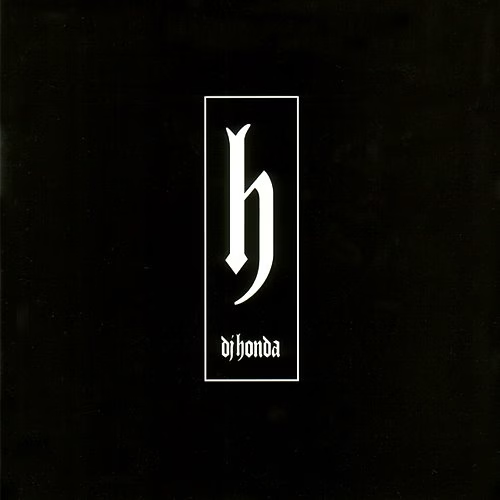
Today is July 2, 2026, marking exactly thirty years since the release of one of the most intriguing street-level projects of the 1990s—the self-titled debut album by Japanese producer and turntablist DJ Honda, simply titled “h”. When Relativity Records pushed this album into global distribution on July 2, 1996, it set a historical precedent that forever changed how we view international hip-hop. For the first time in history, an artist from Asia managed to gather the elite of the New York underground under one roof.
From Tokyo’s Club Scene to New York’s Concrete
Katsuhiro Honda, born in Hokkaido in 1965, took an untraditional path to becoming a hip-hop star. As a seventeen-year-old, he moved to Tokyo with the dream of playing guitar in a rock band called “The Clique“. Financial struggles eventually forced him to seek employment as a DJ in the nearby city of Shizuoka. It was there, in the early 1980s, that he first encountered hip-hop and turntable manipulation techniques. Fascinated by American pioneers like Grand Mixer DXT, Honda spent hours daily honing his scratching skills.
His technical superiority on the turntables eventually led him to New York for the legendary New Music Seminar (NMS) DJ Battle for World Supremacy in 1992. In an epic final battle, Honda finished as the runner-up behind Mix Master Mike. Although he lost the title, Honda gained the most valuable prize of all—the respect of the NYC hip-hop elite and the direct contacts that would soon open the doors to the city’s legendary recording studios.
Two Versions of the Same Classic: Japan vs. The World
Before Relativity Records released the album globally in 1996, the project had actually debuted in Japan on July 1, 1995, via Sony Records. These two editions differed significantly in structure and atmosphere. The original Japanese version ran for 52 minutes and carried a stronger old-school flavor. It featured collaborations with pioneers like Afrika Bambaataa (“Zulu Shout Out”), Erick Sermon (“Game of Death”), Melle Mel (“Cold Blooded”, co-produced by Compton legend DJ Aladdin), and Kurtis Blow (“Old School Jam”).
For the worldwide market in 1996, the album underwent major cuts to suit a gloomier, street-oriented sound. The runtime was trimmed down to 39 minutes and 26 seconds, removing the old-school jams while introducing darker, street-oriented tracks like “Straight Talk from NY” and “Kill the Noize”. This version perfectly captured the late-night boom-bap that dominated the East Coast in the mid-90s.
Heavyweights on the Beats: Who Joined DJ Honda?
The true value of “h” lies in the fact that DJ Honda did not try to reinvent the wheel of hip-hop production; instead, he channeled the existing East Coast sound through his own unique lens. His production was warm, jazzy, and highly suitable for raw lyrical performances.
The timeless classic “What You Expected” brings together Gang Starr. Guru pours his signature monotone yet authoritative flows over a creamy, jazz-infused backdrop that samples The Bar-Kays, while DJ Premier drops his legendary, razor-sharp scratching on the hook. It is the absolute definition of late-night riding music.
“Dat’s My Word” showcases Redman at full throttle. Set over a psychedelic, spacey instrumental featuring samples from Redman’s own song “Where Am I?”, Reggie Noble delivers high-energy flows that create a strange yet hypnotic contrast with the laid-back music.
The biggest street banger on the record is undoubtedly “Out for the Cash“. This classic NYC cipher session pairs Al Tariq, Fat Joe, Problemz, and The Beatnuts. Built around a dusty, slightly out-of-tune piano loop and rugged drums, Fat Joe (Joey Crack) absolutely steals the show, bringing the menacing attitude and street charisma that defined the Bronx during this era.
“Straight Talk from NY” unites two-thirds of Brand Nubian—Sadat X and Grand Puba—alongside rapper Wakeem. While Puba delivers a standout verse calling out Tommy Hilfiger for free promotions, Wakeem’s verse remains controversial for using two Asian slurs—a highly disrespectful move considering he was a guest on a Japanese DJ’s record. Nonetheless, the soulful groove of the beat remains immaculate.
On “Fuk Dat,” Brooklyn newcomer Sean Black (later known as Black Attack) delivers rapid-fire, solid bars over Honda’s most energetic beat, backed by a Buckshot vocal sample on the hook. For a nostalgic touch, Biz Markie drops by on “Biz Freestyle,” reminiscing about Marley Marl and Roxanne Shante over a warm backdrop in his signature comedic fashion. Finally, “International Anthem” features West Coast icons Tha Alkaholiks. Tash, J-Ro, and E-Swift rhyme over an urgent, James Bond-esque loop, blending their lighthearted antics perfectly with Honda’s cinematic production.
Sound Engineering and Street Legacy
The album “h” might not be a revolutionary project that created a new genre, as Honda consciously followed the blueprints laid out by Pete Rock and DJ Premier. However, the technical execution of the project was flawless. The sound engineering, handled by industry legends Jazzy J, Liz Mercado, and Dino Zervos, provided an incredibly clean and warm sonic profile that still sounds fantastic three decades later. The album peaked at number 90 on the US Billboard Top R&B/Hip-Hop Albums chart, which was a monumental achievement for a Japanese producer at the time.
Conclusion: Three Decades of a Global Bridge
Following this project, DJ Honda made a massive leap, launching his own independent label “dj honda RECORDINGS” and creating his iconic clothing line with the lowercase “h” logo, which became a streetwear staple. Today, thirty years later, “h” stands as a monument to a time when hip-hop crossed oceans without the help of the internet or social media algorithms. All it took was raw talent, turntables, and mutual respect between artists from opposite sides of the globe. Happy 30th anniversary to this timeless classic!