The Ultimate Revelation About Rapper’s Delight, Rap And Hip-Hop
Author: Lou Benny
(source: substack.com)
What if I tell you that “Rapper’s Delight” is, while being arguably the greatest swindle of the music industry, also the most important Rap song ever? The song that cryptically pointed to the concept of “Rap”—and its tradition since at least the end of the 1960s—while promoting it into the name of the whole musical and poetic genre that will become the most widely recognized part of Hip-Hop, years before the culture was even named. Bear with me for the next 1000+ words of this take and if you don’t know you will know.
Back in 2006, while reading Jeff Chang’s seminal book Can’t Stop Won’t Stop—a year before I translated it to Serbian with my friend Zoran—I encountered for the first time the controversial genealogy of “Rapper’s Delight”. Throughout the years of reading and listening to the interviews of the greats from that era, I learned the more detailed account of the hustle that gave birth to the song. Sylvia and Joe Robinson’s entrepreneurship, borrowing of Chic’s “Good Times” groove, Big Bank Hank borrowing rhymes from Grandmaster Caz, Coke La Rock… the whole shebang. (Check out Ben Westhoff piece on “Rapper’s Delight” here)
In 2021, while writing my book Good Rap: How I Explained and Completed Hardcore Rap, I focused on the question: “What is a true hard core of Rap, an unchangeable trait or property that gives it its identity?” Looking for the answer as a Hip-Hop head that I am, it seemed promising to try and pinpoint when and how the concept of “Rap” came in play in the historical timeline of Hip-Hop we take for granted.
Checking the old tapes from the NYC recorded at the parties and jams in the 1970s as well as the lyrics from that period preserved in the book The Anthology of Rap (Concrete Books & Records), didn’t amount to much. Back then the people who rhymed to the beat didn’t call it “Rap” or “rapping”, nor did they refer to themselves as “rappers”. Based on my research, the first recording that did contain those words was “Rapper’s Delight”.
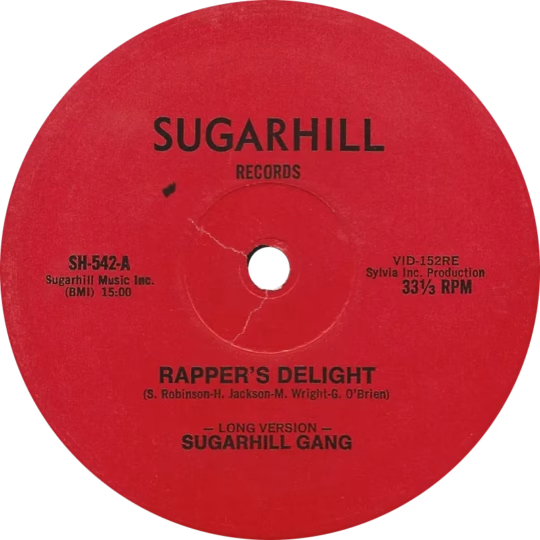
A simple question set everything off: “How ‘Rapper’s Delight’ got its name?” With Big Bank Hank and Sylvia Robinson being unfortunately long gone by that time, I felt I had no one to ask because, from what I knew about the whole operation, I believed one of them was in charge of the naming. However, the song itself and its lyrics were still available, so I dived in.
Using search option, I found that in the original, long version of the song, throughout its ~370 bars, words “Rap”, “rapping” and “rapper” appear a total of seven times. None of it, though, was significant enough to spark a breakthrough or push me in a new direction.
The first of the three appearances of the word “delight” miraculously did all of that and much more. It’s in the rhyme “Well, I’m Imp the Dimp, the ladies’ pimp / the women fight for my delight” and it literally turned out to be the rabbit hole I fell into in order to discover the true history of Rap.
The first clue that led me to this d̶i̶s̶c̶o̶v̶e̶r̶y̶ revelation was the information Rahiem of the Furious Five conveyed to Shawn Setaro in an interview back in 2013 which I found in the Genius annotation to the said rhyme. He said that it was the rhyme that made him famous in the Bronx in the 1970s but, unlike Big Bank Hank who took it from his live performances, he borrowed it from a book, and it was none other than Die Nigger Die! (1969), the political autobiography of the great H. Rap Brown. Allegedly, when H. Rap Brown was serving time in the 1970s (in Attica?), he heard from his fellow inmate, Rahiem’s brother, the story of the guys who were rhyming to the beat in the Bronx at the time. He sent the signed copy of his book to Rahiem, via his brother, and wrote him to “get inspired”.
And there, at the second chapter of his book, H. Rap Brown tells a story about his childhood in Louisiana in the 1950s. He delves into the everyday lives of the poverty-stricken Black kids and writes about battling verbal games of Dozens and Signifying he and his friends used to play. But, “before you can signify you got to be able to rap” he intriguingly wrote there, and then went on to present “rap” rhymes that he used to spit at those lyrical throwdowns, the rhymes that eventually earned him his nickname “Rap”.
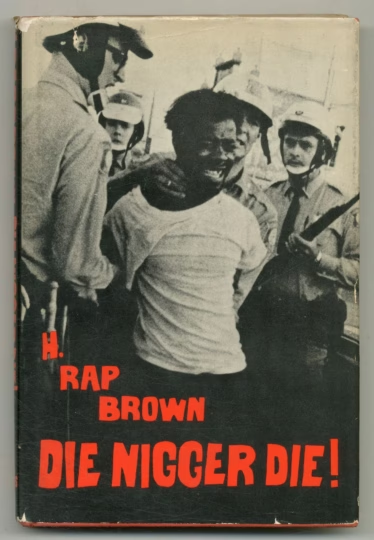
In those 40 or so lines he is just bragging and boasting without verbally attacking anyone until he ends it with a personal jab at his opponent which suggests that the Dozens or Signifying battle is incoming. The same thing that Big Bank Hank—with Wonder Mike and Master Gee to a lesser extent—did throughout “Rapper’s Delight” while adding a few party rhymes and even a few battling rhymes about “sucker MCs” or jabs at the Superman and his unsatisfyingly “little worm” (pause). All of it shed a new light on the title of “Rapper’s Delight” with questions like who is that cocky rapper in the title—the ladies’ pimp—for whose delight (pause) women are fighting. I’m not saying that H. Rap Brown inspired and laid the foundation for Rap as we know it from 1979 onwards, you are saying that.
So, that’s how I formed my main thesis that bragging and boasting or—written in Hip-Hop terms—pure represent without battling elements is the essence, the hard core of Rap. That’s the reason why I claim that “Battle Rap” is a self-contradictory concept, that the ultimate goal in Rap is not being “better” or “the best”, but the absolute good (god), hence Good Rap. That’s where my elaborate idea of the difference between a rapper and a Hip-Hop emcee comes from, saving The Sugarhill Gang and other rappers from being downplayed by their peers as nothing more than “fake MCs” (as seen in JayQuan’s interview with Kid Creole). That is as well the birthplace of my claim that “rapping”—as the name for the vocal technique of rhythmical syncopation of a string of spoken rhymes with the underlying beat—comes from “Rap”, i.e. bragging and boasting, which was the subject matter of the first rhymes syncopated to the beat, implying that a person rapping is not necessarily spitting Rap, and so on.
I thoroughly wrote about all of that in my book Good Rap which is currently still available only in Serbian, but I will present the different facets of my interpretation of Rap and Hip-Hop here in a series of posts. There is also the whole story about pimps and other African American hustlers from the ‘60s and ‘70s that provide circumstantial but strong evidence for my interpretation and for their role in shaping Rap tradition which is, funny enough, winked at in H. Rap Brown’s “the ladies’ pimp” self-reference.
Moreover, as I later found out, there are respected people from Hip-Hop community who also emphasized the importance of H. Rap Brown and his rhymes in the context of Rap’s naming. The great Hip-Hop historian Dave ‘Davey D’ Cook said the same thing or at least hinted at it in his article “An Historical Definition Of The Term Rap”. He went into detail there about H. Rap Brown’s rhyme used in “Rapper’s Delight”, mentioned that it even appeared in the classic African American movie Five on the Black Hand Side (1973), and wrote about the examples of Dozens and Signifying rhymes H. Rap Brown presented in the book Die Nigger Die! (1969).
The great KRS-One himself also cites all of those H. Rap Brown’s bragging and boasting rhymes in his book The Gospel of Hip-Hop (2009), but using them as an evidence for the claim that Hip-Hop goes way back. Although I’m willing to embrace his claim from a Hip-Hop head’s point of view, I believe that there are more than enough arguments in favor of interpreting H. Rap Brown’s rhymes as the part of the older Rap tradition which was assimilated by Hip-Hop once the culture was formed and named.
To cement H. Rap Brown’s status of the most influential figure at the very beginning of Rap as a musical and poetic genre, there is another song from the 1979 which was probably inspired by his “rap” rhymes from 1950s Louisiana. It’s the “Wack Rap” by Wackie’s Disco Rock Band, a somewhat mysterious track ‘cause no one seems to know the exact date of its release. However, that song contains the lyrics: “’Cause I’m an ass kicker, the titty licker / The crowd pleaser, the women teaser” which are wildly similar to H. Rap Brown’s: “They call me Rap, the dicker, the ass kicker / The cherry picker, the city slicker, the titty licker”.
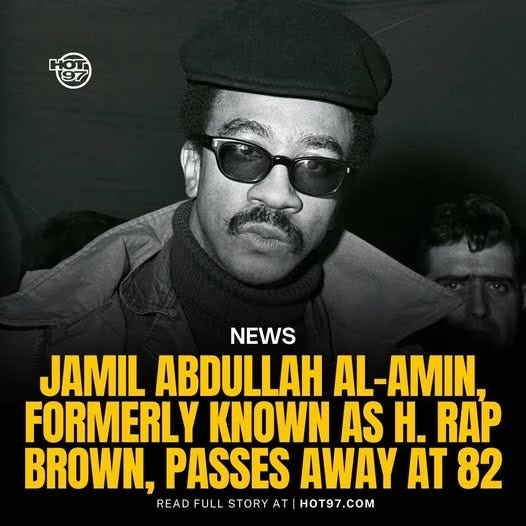
Unfortunately, a four months ago we’ve lost the ultimate Rap pioneer that Mr. Jamil Abdullah Al-Amin a.k.a. H. Rap Brown was and is without a doubt. On November 23rd, 2025, he passed away in FMC Butner federal prison in North Carolina while serving a life sentence for the shooting of two Fulton County, Georgia, sheriff’s deputies in 2000. The man who was born, raised and died in the South, inspired New Yorkers to create the musical and poetic genre that went on to take over the whole world. May he rest in peace, and may we all start digging deeper and connecting the dots to come up with the real history of this thing, not just chronicles and archives.
You must be logged in to post a comment.