The Engineer Who “Healed” Hip-Hop Sound (R.I.P. Bob Power)
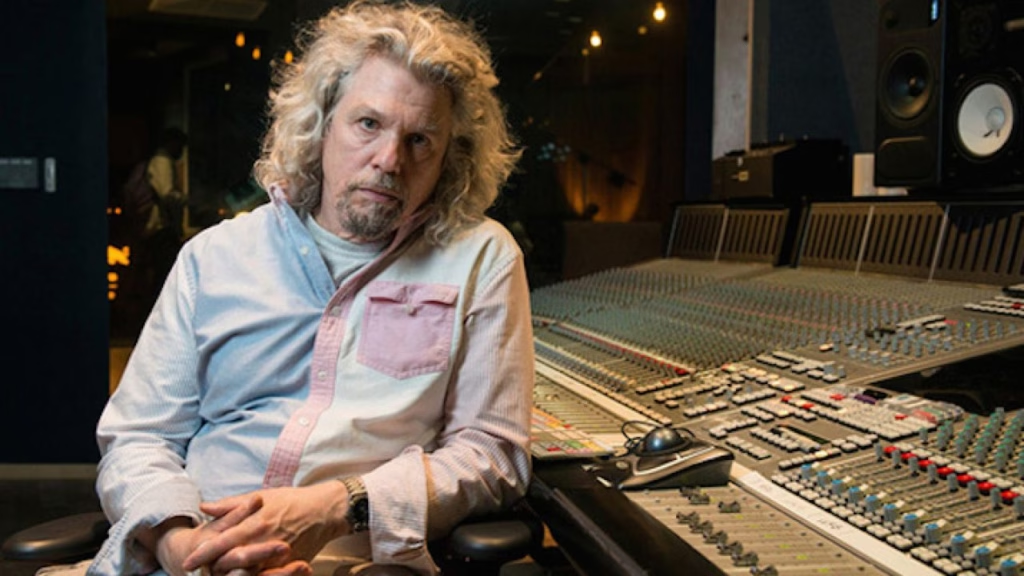
When discussing the “Golden Era” of hip-hop, the first association is usually an MC with a microphone or a producer digging through crates for that perfect sample. However, there is a man who stayed behind the boards, and without whom that signature 90s “boom bap” sound might never have achieved such high-fidelity clarity and power. His name is Bob Power. If you’ve ever felt that deep, warm bass hitting your chest while listening to A Tribe Called Quest or De La Soul, you were likely experiencing his handiwork.
Bob Power wasn’t your typical “guy from the hood.” Born in Chicago in 1952, Bob was a musically trained professional with degrees in classical composition and jazz. Before stepping into the rap world, he spent years scoring music for commercials (Coca-Cola, AT&T) and television series, even earning an Emmy Award for his efforts. His pivot to hip-hop occurred almost by accident at Calliope Studios in New York City. The studio was essentially an incubator for the Native Tongues collective, and Bob was one of the few engineers at the time who didn’t view rap as “noise,” but as legitimate musical art.
The studio owner asked him to sit in as an engineer for a session with Stetsasonic, a group that was pioneering the transition from live instrumentation to complex sampling. Power’s formal musical background allowed him to effectively translate the group’s vision into professional “sizzling frequencies,” leading him to oversee the sessions for their 1986 debut album, On Fire. This collaboration was historically vital as it forged a professional bond with the group’s visionary producer, Prince Paul, which eventually connected Power to the wider Native Tongues collective and cemented his role as the architect of their sophisticated, jazz-infused sound.
His most significant contribution is arguably his work on A Tribe Called Quest’s The Low End Theory. Q-Tip and the crew had a specific mission: they wanted the bass to be the center of the universe. At the time, technology was severely limited—samplers like the Akai S900 or SP-1200 had barely a second or two of memory. Bob stepped in as the architect. He manually cleaned every sample of vinyl crackle and pops (since noise-reduction software didn’t exist yet) and reconstructed musical phrases to ensure everything felt coherent. He gave the bass “weight” without the muddiness, utilizing the famous “Pultec trick” and DBX 160 compressors to lock everything into the mix .
Later, during the sessions for Midnight Marauders, Q-Tip instructed him “not to clean anything up,” as they wanted a gritty, street-style vibe that sounded like music blaring from a jeep in a crowded Brooklyn neighborhood . That transition from polished jazz-rap to raw street aesthetics proved how adaptable Power was. He also worked extensively with De La Soul on pivotal projects like De La Soul Is Dead and Buhloone Mindstate, seamlessly blending live jazz horns with sampled beats.
His influence extends deep into the neo-soul movement as well. He is the man who shaped the sonic signature of D’Angelo‘s Brown Sugar and Erykah Badu’s debut Baduizm. His philosophy was always simple: “Make good music with good people”. Even as the industry shifted into the digital era, Bob remained active, always open to new tools while maintaining his deep knowledge of harmony and frequency .
In the latter part of his career, Bob dedicated himself to education, serving as a professor at NYU’s Clive Davis Institute. There, he taught generations of students that an engineer isn’t just a technician, but a “sonic midwife” helping to bring an artist’s vision to life . Bob Power passed away in March 2026, but his “low end” will continue to thump as long as hip-hop exists. He didn’t just mix tracks; he set the gold standard for how modern Black music should sound—warm, deep, and timeless.