Supreme Clientele: Ghostface’s Blueprint for Wu-Tang’s Comeback
Author: RAProgram
By the late ’90s, Wu-Tang Clan wasn’t a mystery — it was an institution. Too many releases, no clear direction, RZA stepping back. Critics were questioning if the empire could still innovate.
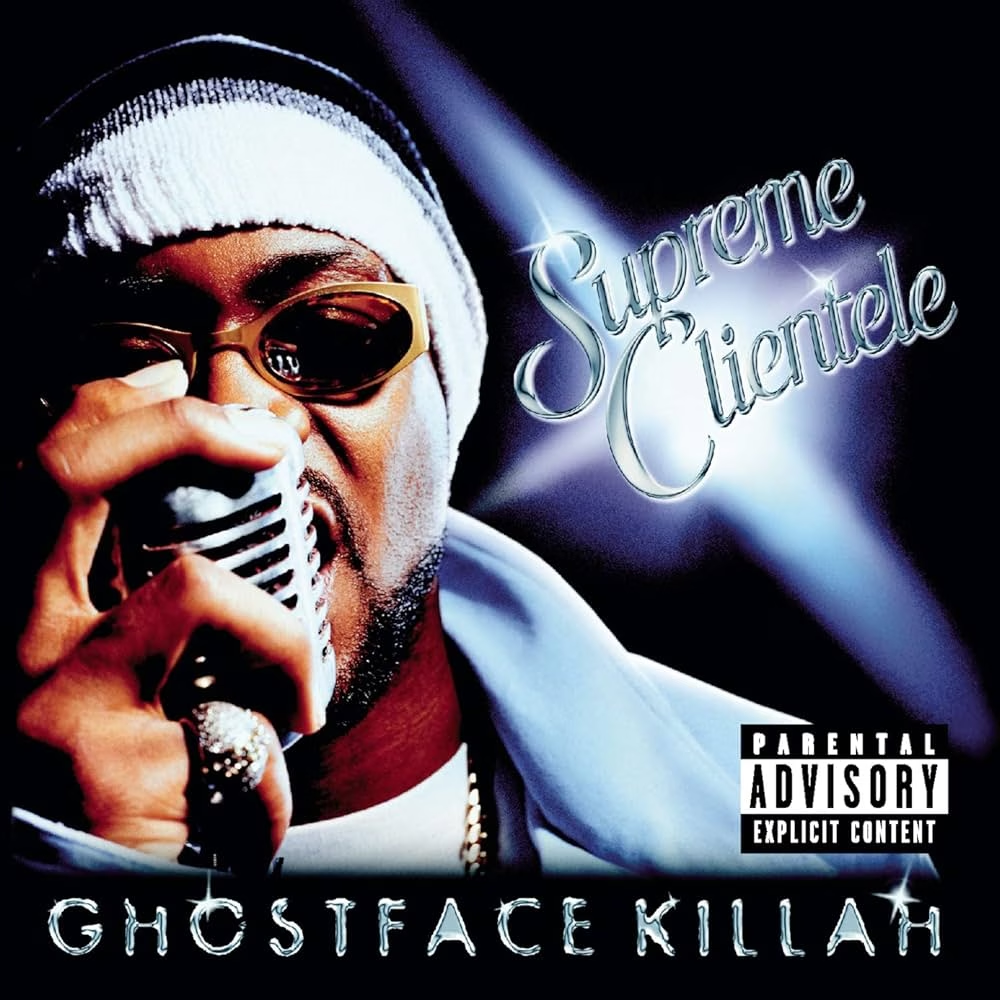
Then Ghostface Killah dropped Supreme Clientele. Not to save Wu-Tang — but to remind everyone what it truly was. Recorded across New York and Miami, written from Africa to Riker’s Island, Ghostface collected beats from JuJu, Mathematics, Inspectah Deck, Haas G, and even his Staten Island barber, Black Moes-Art. RZA acted as executive conductor, piecing the instrumentals into raw, soulful, and emotional soundscapes.
Ghostface’s rap isn’t conventional. His rhymes are chaotic but precise — thoughts rhyme, not just words. Lines hit in waves: childhood, hunger, luxury, paranoia, humor, trauma. Tracks like Nutmeg broke traditional narrative, becoming a blueprint for abstract street rap. Mighty Healthy lets rhymes dictate rhythm over a heavy, minimal beat. Apollo Kids is aggressive, energetic, and unapologetically raw. Together, they define Ghostface: cinematic, unpredictable, and fully in control.
Raekwon, U-God, Method Man, Redman, Cappadonna, and GZA appear, but no one overshadows him. This is Ghostface’s film; everyone else passes through the scenes.
At a time when mainstream hip-hop was polished and predictable, Supreme Clientele brought back grit, soul, and real tension. DJs kept it in heavy rotation because it felt real. The streets embraced it because it kept it 100. Critics praised it because Wu-Tang’s creative pulse was alive again. The “Wu falling apart” narrative went silent.
This album didn’t just restore Ghostface’s reputation — it reminded the world of Wu-Tang’s essence: attitude, style, and atmosphere. It also inspired a new generation of artists — Roc Marciano, Ka, Mach-Hommy, Griselda — carrying pieces of its minimalist, abstract, and emotionally raw DNA.
Compared to Ironman, which was dark but tightly structured, Supreme Clientele feels rawer, grimier, and far less concerned with playing by the rules. Ironman proved Ghostface could stand alone; Supreme Clientele proved he could hold it down while everything was unstable.
The album mattered — not because of sales, but because it restored faith. It’s the sound of a mind without filters, of a collective rediscovering itself, and of Staten Island after dark. If Wu-Tang is a religion, this is one of its defining chapters.
BARS>NUMBERS