Richie Rich: The Forgotten Architect of UK Hip-Hop & House
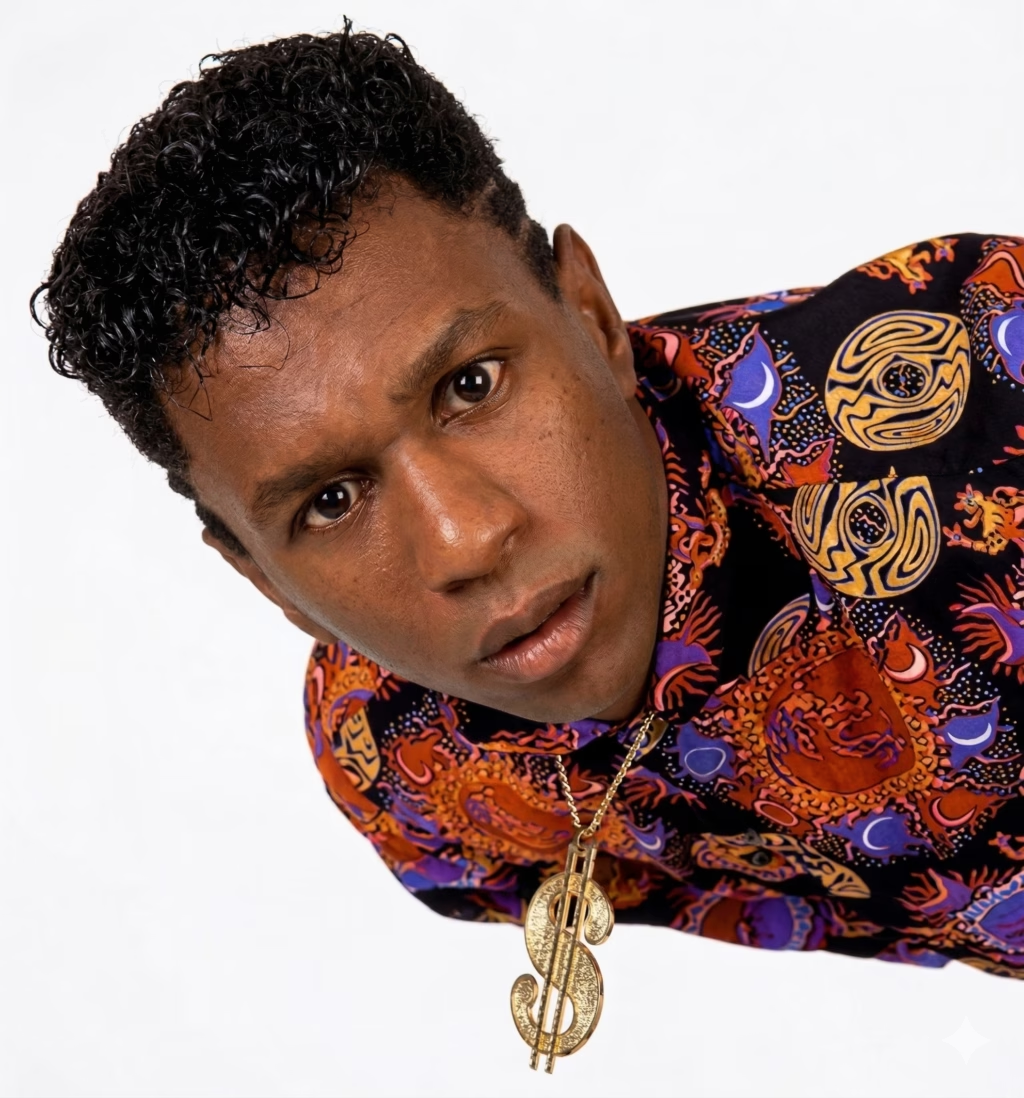
In the history of British urban music, some names shine brighter than others, but true heads know that the most crucial foundations were often laid by figures who are somewhat forgotten today. Richard Morgan, better known as Richie Rich, is one of those architects. While today’s kids are obsessed with drill and grime, Richie was the one who defined what it meant to be a DJ, producer, and “label boss” in the mid-80s, while London was still shrouded in the fog of pirate radio waves.
Richie Rich built his reputation where real music was always forged – on pirate radio stations. Starting in 1986, he was a key component of the then-pirate Kiss FM, which operated outside the law on the 95.3 frequency. His show, “Good Groove”, was essential listening for every head in London. Richie wasn’t just a selector; he was a technician, airing his own edits and “cut-n-paste” mixes, educating a generation that would later ignite the warehouse rave revolution. When Kiss FM became a legal station in 1990, Richie continued with the “Rap Academy” show, cementing his status as one of the most influential radio voices until 1992.
Perhaps the most significant move in his career was the founding of Gee Street Records in 1985. Richie co-founded the label with Jon Baker, Rachel O’Neill, and the Stereo MCs (Rob Birch and Nick Hallam). The name came directly from the location – their studio in a converted warehouse on Gee Street, off Old Street.
The story of how the studio came to be is quite legendary. A real estate developer wanting to demolish their flats paid Richie and Jon £7,000 each to move out, and they invested that money directly into gear and space. Gee Street became an incubator for a sound that merged raw hip-hop with London’s club energy, releasing names like Jungle Brothers, P.M. Dawn, and of course, Stereo MCs.
A never-before-seen TV interview from 1988 recently “leaked” online, offering an incredible insight into Richie’s mindset at a time when hip-hop and house were beginning to change the world. In this deep dive, Richie explains the rise of the club scene and draws a parallel between this music and classical, claiming it wasn’t just a fashion, but a sound that would always be there.
In the interview, Richie criticizes mainstream clubs for their strict dress codes (banning “drainer” jeans) and explains why the real energy was in the warehouses. He also precisely demystifies the “Acid House” term, explaining that it refers to sounds and samples, not necessarily drugs, which the British press at the time was desperately trying to push.
His discographical path is fascinating because it shows his versatility. His biggest hit, “My DJ (Pump It Up Some)”, released in 1988, became an absolute classic. It was an energetic bomb of scratches and breaks that showcased Richie’s full power as a turntablist.
However, Richie was a man who loved a challenge. There is a famous story about a bet with Jazzy M (the godfather of UK house). Jazzy bet that Richie, as a hip-hop DJ, couldn’t make a proper house track. Richie responded with “Salsa House”. The result? One of the most important house anthems of that era, which was even released as a US import to “trick” DJs into thinking it came from Chicago or New York.
In 1989, he released his full-length album “I Can Make You Dance”, which perfectly summarized the “hip-house” vibe of the time. The album was packed with collaborations, including Jungle Brothers and Sugar Bear, with engineering handled by Nick Hallam of the Stereo MCs.
After Gee Street was acquired by Island Records, Richie moved to Jamaica with partner Jon Baker, where they founded the legendary Geejam studio and hotel. There, he continued to work “under the radar,” producing for names like Rihanna, Drake, and Gorillaz. While younger generations might not recognize him on the street, his stamp on British music is indelible.
For those wanting to dig deeper into his discography, make sure to visit his Discogs page. Richie Rich remains a reminder of a time when music was raw, genre boundaries were non-existent, and pirate radio was the only window into the future.