Once Upon a Time in America: Pure Brooklyn Rap DNA
Author : RAProgram
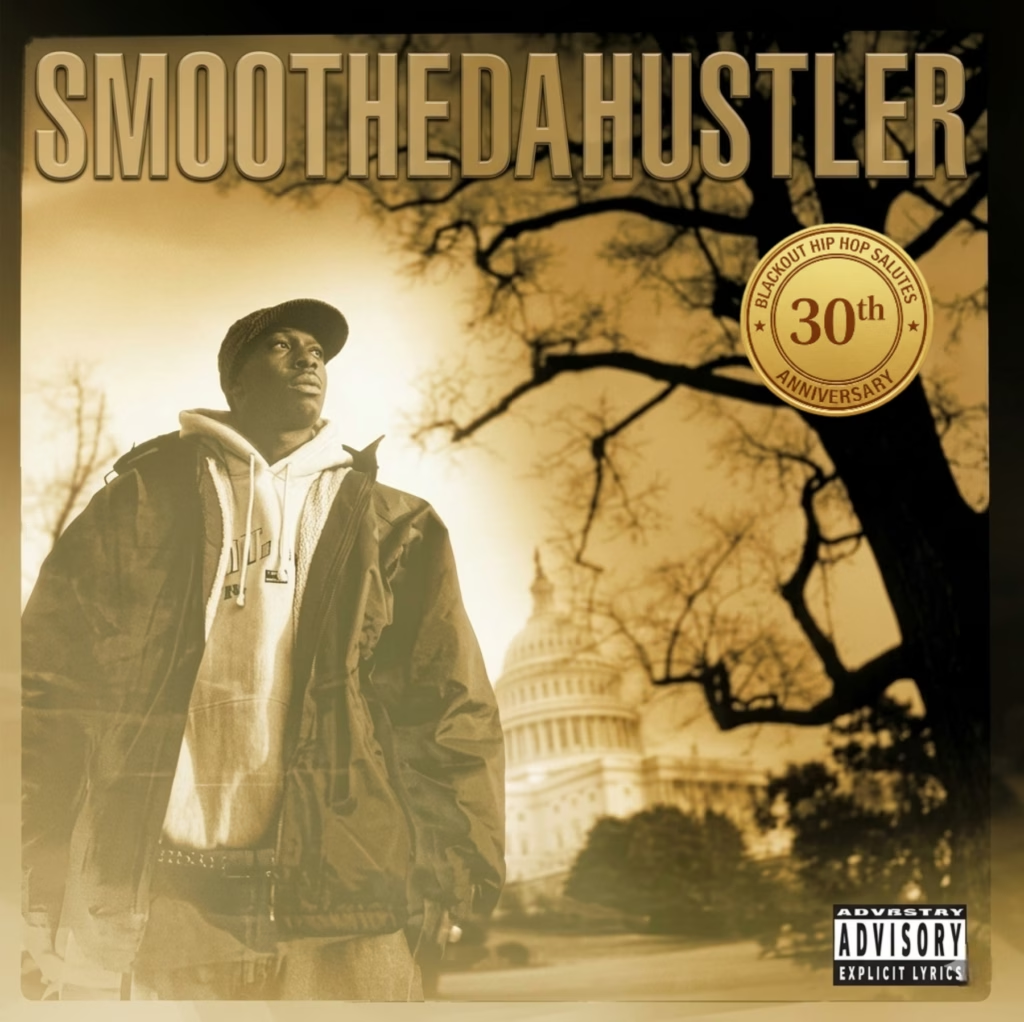
Once Upon a Time in America, the album by Smoothe Da Hustler released on Profile Records, still hits, 30 years later, like a time capsule from an era when New York hip-hop was raw, hungry, and uncompromising. A street manifesto from a time when rhymes were currency and reputation was everything.
Smoothe emerged in the mid-’90s as part of the Brooklyn scene, from a neighborhood where credibility meant more than any hype. Even before the album dropped, he was already making noise through singles and appearances, but the real breakthrough came with “Broken Language”, a track that instantly set him apart as an MC with a completely different flow and approach to rhyme. He wasn’t industry-made, he was raw talent bubbling straight up from the underground.
The album’s sound is handled almost entirely by Brooklyn veteran DR Period, with one track produced by Kenny Gee. It’s the same blueprint we saw back in ’94 on M.O.P.’s debut, where DR Period also handled the full production except for one cut, giving the project a unified and recognizable sonic identity.
DR Period would later gain wider recognition as the man behind “Ante Up,” but here we catch him in his grimiest, most stripped-down form.
The sound is dark, minimalist, and rugged – drums hit with no mercy, samples are cinematic and eerie, and the whole atmosphere feels like M.O.P. might burst in from Brownsville at any second and set it off even further. But they never do, and that absence creates an added layer of tension throughout the record. Still, Smoothe holds it down more than solid, clearly someone who’s been sharpening his craft since early on.
Thematically, the album is deeply rooted in street reality: hustling, brotherhood, loyalty, survival, and reputation. No glam, no filters, just raw truth poured into bars.
Smoothe’s voice is one of his strongest weapons – gritty, raspy, relentless, yet tightly controlled. His flow is fast and technically sharp, packed with internal rhyme schemes that stack flawlessly. He doesn’t just ride the beat, he cuts through it, bends it, and uses it as a canvas for verbal acrobatics without ever losing clarity or groove.
A central presence among the guests is his real-life brother, Trigga Da Gambla. Their chemistry sounds like the result of years of going back-to-back—like they grew up finishing each other’s bars in real time.
Then there’s DV Alias Khrist, often dubbed the “East Coast Nate Dogg,” which you can definitely feel on “Dollar Bill.” Kovon also shows up, handling most of the melodic hooks, simple but effective, and surprisingly catchy for such a raw project. Dawn Tallman plays a similar role on “Neva Die Alone,” one of the more laid-back cuts that reflects on the origins and evolution of Smoothe’s hustler mindset.
“Broken Language” – A technical tour de force. One of the first rap tracks without a hook to land on the Billboard singles chart. The back-and-forth between Smoothe and Trigga feels like a perfectly calibrated machine – no wasted motion, no missteps. That endless series of self-aggrandizing descriptions turns the track into a street-level phenomenon.
“My Brother My Ace” – A brotherhood anthem. Pure loyalty and emotion delivered with brutal honesty.
“Hustlin’” – Straight street energy. Minimalist beat, direct bars—pure banger.
“Hustlers Theme” – The core of the album. All its key ideas and aesthetics condensed into one track.
“Murdafest” – The rawest, most aggressive moment on the record. It feels chaotic, but it’s actually razor-controlled.
The album balances heavy hitters with slower, atmospheric cuts that play like hardcore street ballads. The skits are carefully placed and cinematic in function, they connect the tracks and give the project a sense of continuity, like you’re listening to one long story broken into chapters.
Once Upon a Time in America is a certified classic. Not the kind pushed by radio or MTV, but the kind built by the streets and real hip-hop heads. Unfortunately, it never reached a wider audience, which left it forever locked in the underground.
But that’s exactly where it belongs. Because among real heads, this isn’t just an album – it’s a benchmark. Proof of what it sounds like when authenticity, skill, and street spirit are at their peak.
BARS > NUMBERS