Marc Ecko’s Getting Up: 20 Years of Street Revolution
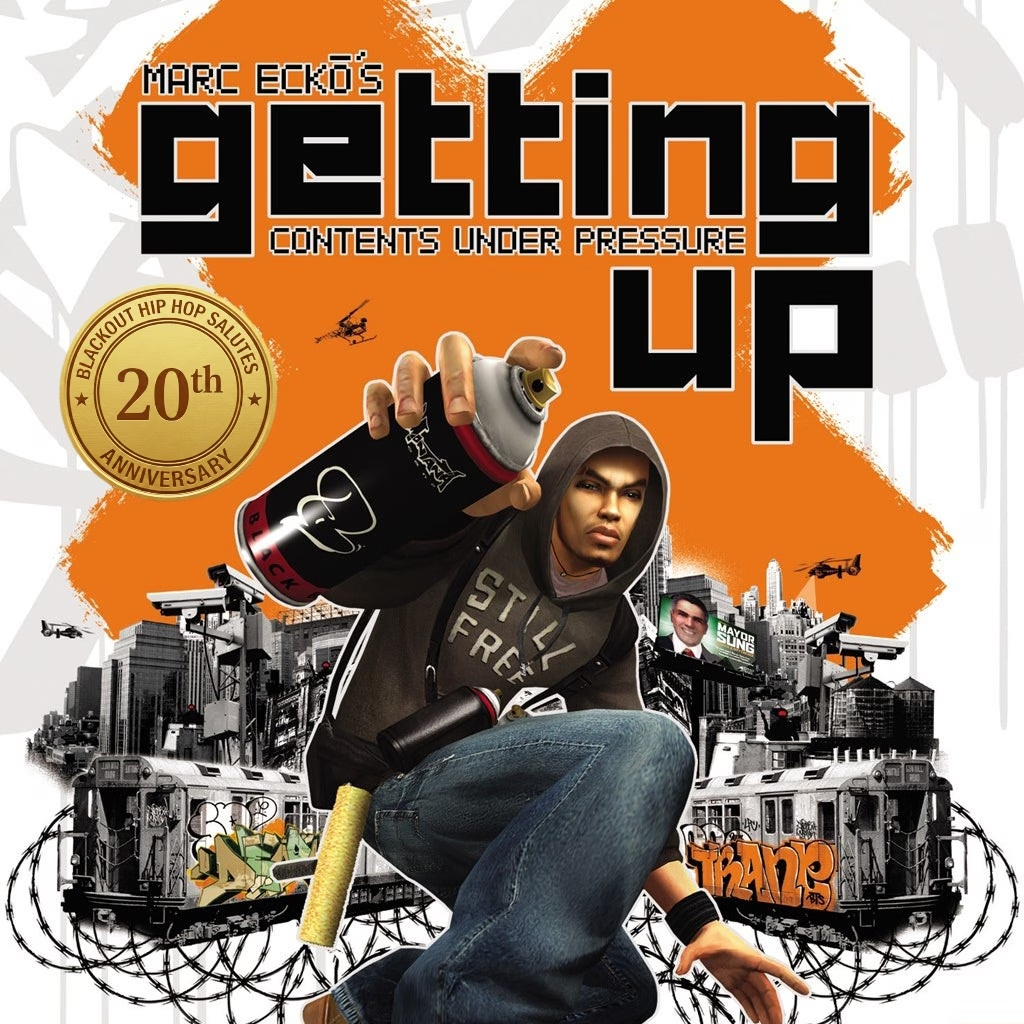
Today is February 14th, and while most people are out there stressing over Valentine’s Day plans, we’re digging into a different kind of anniversary. Exactly 20 years ago, on February 14, 2006, the world of gaming and hip-hop culture collided in a way we hadn’t seen before. I’m talking about Marc Ecko’s Getting Up: Contents Under Pressure.
Developed by The Collective and published by Atari, this wasn’t just another licensed title pushed out for a quick buck. This was a seven-year labor of love from Marc Ecko himself—a man who, before the rhino logo became a global streetwear staple, was a writer in the trenches. He wanted to create a digital archive for the culture, and looking back two decades later, he did exactly that.
The game follows Trane, voiced by the legendary Talib Kweli, a “toy” (novice writer) trying to make a name for himself in the dystopian city of New Radius. The setting itself is a vibe—a mix of 80s NYC grit and Hong Kong density, governed by the tyrannical Mayor Sung. Sung’s mission? Gentrify the city and wipe out the “filth” of graffiti using his fascist CCK (Civil Conduct Keepers). Trane’s journey starts as a personal quest for “All City” status, but it evolves into a full-on political rebellion.
What made Getting Up stand out wasn’t just the platforming or the street fighting—though shoving a CCK officer off a ledge had its charms—it was the authenticity. Ecko brought in over 65 legendary graffiti writers to contribute their art and signatures. We’re talking about heavyweights like Cope2, Futura, Seen, T-Kid 170, and Shepard Fairey (OBEY). These weren’t just cameos; legends like Futura and Smith actually mentored Trane, teaching him about “black books,” “heaven spots,” and the ethics of the street. It was an education for anyone who didn’t grow up with a can in their hand.
Of course, we have to talk about that soundtrack. Executive produced by RJD2 and The RZA, it’s arguably one of the best licensed soundtracks in history. From the “Getting Up Anthem: Part 1” featuring Talib Kweli and Rakim to Mobb Deep’s “Shook Ones Part 2,” the music was the heartbeat of New Radius. The RZA and RJD2’s original score would transition from ambient stealth beats to heavy, bass-driven tracks during combat. Hearing “Who Shot Ya?” (the Serj Tankian remix) while tagging a high-security spot gave the game a flavor that felt like a real hip-hop documentary.
However, let’s keep it 100—the game wasn’t perfect. Critics at the time pointed out the janky camera and the sometimes clumsy combat system. It was linear in ways that frustrated players who wanted a full open world. But for the heads, those flaws didn’t matter as much as the feeling of “bombing” a subway car to the beat of Grandmaster Flash.
The game was so effective in its message that it actually got banned in Australia. The OFLC refused to classify it because they claimed it “promoted the crime of graffiti.” Marc Ecko didn’t back down, taking on NYC Mayor Bloomberg in court for trying to stop the game’s launch event. It was a landmark moment for video games being recognized as protected speech.
Fast forward to today, 2026. The game has found a new life on Steam through Devolver Digital, and there’s even a film adaptation, Getting Up: Legends of New Radius, in the works. Whether you’re an old-school head who played it on the PS2 or a new writer just discovering Trane’s story, Getting Up remains a singular moment where street art was given the respect it deserved in the digital space. Still Free.