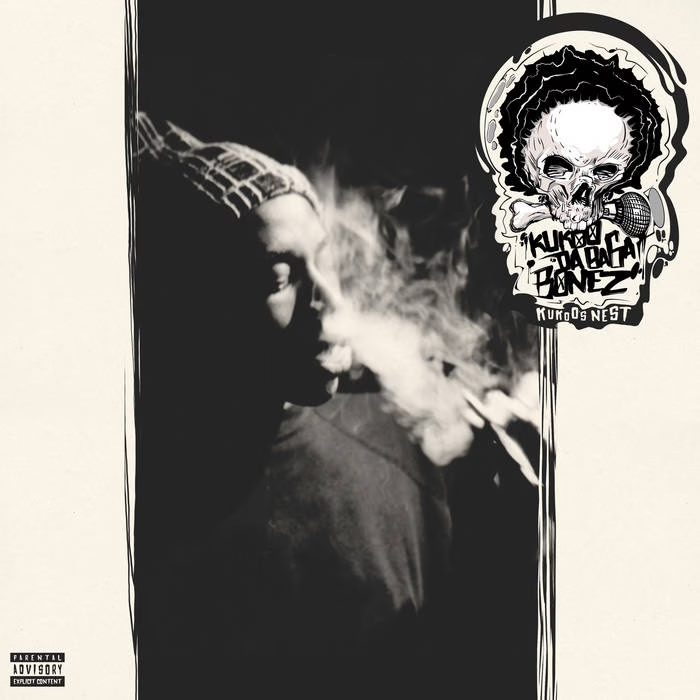
90’s Tapes presents: Kukoo Da Baga Bonez – Kukoo’s Nest
…connection to hip-hop’s foundational elements.
It’s no secret, the 90s were truly the golden age of hip-hop, with a countless number of artists emerging from every dark back street and alley, giving birth to the most diverse spectrum of styles within the rap element. The music had such a distinctive sound back then; it really gave a special feel when listening to those releases. All of that had to do with the infinite creativity of producers, but also the warmth and interesting saturation due to various analog equipment studios were using. Combine that with raw and unfiltered lyrical styles and delivery, hip-hop of the 90s, which reflected in the early 2000s underground, gave an unique listening experience that resonates even today with many of us, both the old and the young’uns.
The downside was the fact that many tracks and even full albums didn’t get their moment to shine as many labels faced financial struggles, bankruptcy and legal disputes of various kinds, which resulted in many materials being poorly promoted upon release or not released at all (like Darc Mind‘s classic joint “Symptomatic of a Greater Ill” that was supposed to be released in 1997 for Loud Records, but due to the label’s shutdown, the album was shelved until 2006 when the Anticon label stepped in). Also, as there was a huge number of MCs trying to get their piece of the cake, many of ’em were outshined by other projects that were released about the same time as theirs. Remember how Craig Mack‘s debut “Project: Funk da World” was completely shadowed by Biggie‘s first album? Exactly.
Now, with the enormous number of artists surfacing from every corner, all keen on technically outmatching the other guy, to be given a chance to get noticed, let alone getting a record deal, was a really hard thing to do, and it took a great deal of luck, or at least having more powerful acquaintances in the industry to give a bit of a push. That resulted in many MCs not being able to move on from their demos and a few singles, no matter how good they were, just like our guy Kukoo Da Baga Bonez here, even though he created quite a buzz in the underground when he came out with the single “Real Kukoo” back in 1996.
The track got him on the map, especially when The Source included it in the list of top 10 independent hip-hop singles of the year, which led him to collaborate with well-established names like members of the X-Ecutioners crew and DJ Krush, and even went for a European tour with DJ Angola some years later (followed vy a Japan tour with Krush). However, regardless of such accomplishments, he never managed to maintain the momentum after “Real Kukoo” as mainstream labels didn’t render him as sale-worthy, leaving him with several singles in rotation until he succeeded to record a full-length album with the rapper World called “Insane Psycho Home”, released in 2002. It was not until 2007 when he finally released his debut album, named “Da Grustler,” showing that he didn’t back down but remained true to the game, and was willing to share old and new stories of his grind and hustle within and outside of the US of A.
But what of his earlier work? With a few singles of his own, there was much more recorded material that collected dust in his mom’s house. Considering the reputation he had in the late 90s, many were wondering what could’ve become of the Brooklyn-born MC if he had gotten a record deal. Well, with all the might of the 90’s Tapes crew, we now have a chance to hear what that would sound like. In an effort to revive almost forgotten and never-released material, Kukoo Da Baga Bonez now has all of his early work compiled into one full album, symbolically dubbed “Kukoo’s Nest.” That being said, we’re going back to his days in the 90s, to his roots based in the New York underground, filled with freestyle sessions, rap battles, and youth energy combined with the unfiltered ruggedness of the hip-hop scene in the last decade of the 20th century; a trademark, really, of all the artists that weren’t blinded by the flashy light of the mainstream.
Raw, uncut, and demo’esque.
For starters, you have to look at this album from a 90s perspective, as a modern way of looking at music won’t cut it. Kukoo was and is a fantastic MC, but don’t expect overly complicated rhyming schematics you can find nowadays. Instead, he’s pretty much direct and shares smart lyrics filled with classic NY hardcore rap punchlines. The brother isn’t selling himself as a gangsta rapper that talks about imaginary scenarios, but mostly realistic stories combined with classic braggadocio. Of course, his boasting is not pushed to the maximum, and he maintains a neutral line between excessiveness and reality, which comes as a refresher in a world filled with perpetrators. Compared to his work in the new millennium, his mentality in the 90s wasn’t that much different in terms of not acting like something he’s not. Kukoo keeps it real and has skills for show & prove. Some would say he wove street narratives into punchlines like he was narrating life in NYC with every bar, with a healthy dose of cheeky humor. That mixture of Brooklyn and Queens running in his blood gave zest and a somewhat unique energy to his music. It’s a fact that some were inspired by his singles for their own stuff. There’s also a story that Mobb Deep, after hearing Kukoo‘s version of “Trife Life,” they recorded a version of their own. But, that’s a story for another day.
As you can imagine, most, if not all, of his material was saved on cassette tapes and DATs, probably left in a box somewhere in the basement or attic, so it took a while to re-mix and re-master the music as the original recording process was of questionable quality, I reckon. Nevertheless, the authenticity literally bleeds out of this album as nothing was overdone in the process. That demo-ish flavor was well kept here, which is a fantastic way to promote music from that era, especially with Kukoo‘s tracks that weren’t released before, like, ever. That being said, “Kukoo’s Nest” features 23 tracks in total, which includes all of the 12″ singles, B-sides, remixes, instrumental versions, and the previously unreleased songs. He was real busy as a young buck growing up on the streets of Queens, and, luckily, he was given a chance to put these gems out.
Instrumentally, the producers didn’t move an inch from the atmosphere Kukoo provided lyrically. I imagine that younger generations could see this album as dull as a result of their lack of will to dig deeper. The beats are somewhat simple, yes, but do provide a lot. The thing is, they’re giving the lyricist a lot of headroom to maneuver with his techniques, and since he has a strong, dominant presence, to remain in the middle of the sound image with no oscillation. No matter the simplicity, the beats own the word ‘gritty’ and also showcase the New York authenticity of that era. It’s dim and shadowy, just like the streets that inspired his music, so there’s a pretty well-painted picture of their surroundings without too much unnecessary plethora of violent imagery. Even when you listen to the solo instrumentals, you’ll find a way to enjoy that sonic simplicity pretty fast and discover yourself bumpin’ your head to ’em while having a stroll.
All in all, this album is a fantastic piece of history that almost got lost in the nothingness. Fortunately, that wasn’t the case, so heads today can enjoy Kukoo‘s music from the days when he was in his prime. Since the dude already had a fair amount of attention back then, there’s no wonder he could stand shoulder to shoulder with some of the prominent artists NYC had then. I doubt every hip-hop head will find satisfaction with the album as tastes really do vary, and some of the new generations are salty with the term “boom bap” and its era. Whatever the case may be, this one’s a fine release that would, in those years, probably light a lot of fires on radio stations and boomboxes on the street corners as Kukoo had all it takes to be on that level. I see him like some of the Wu-associates in the golden age of Wu-Tang; there were some top-notch MCs when the Wu family was peaking and expanding rapidly, but still didn’t get that much shine they actually deserved. If you’re looking for real hip-hop with no gimmicks, this one’s for you. “Kukoo’s Nest” doesn’t imitate the golden era sound – it is the golden era. For longtime heads, it’s a welcome archival release. For newer listeners digging beyond the copy-paste mainstream narratives, it’s a reminder of how deep the culture runs beneath the surface. Whether you’re already familiar with Kukoo Da Baga Bonezor just discovering him for the first time, this album stands as a testament to a period when hip-hop thrived stricly on skill, community, and uncompromising identity.
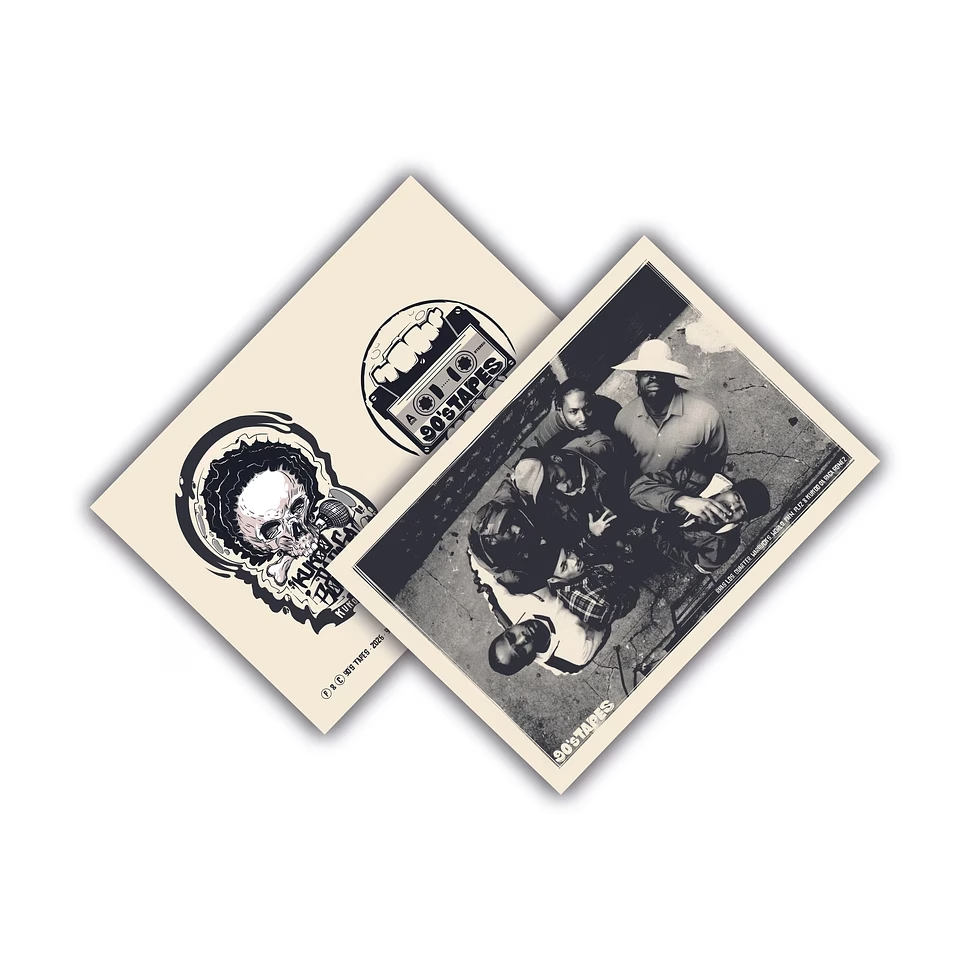
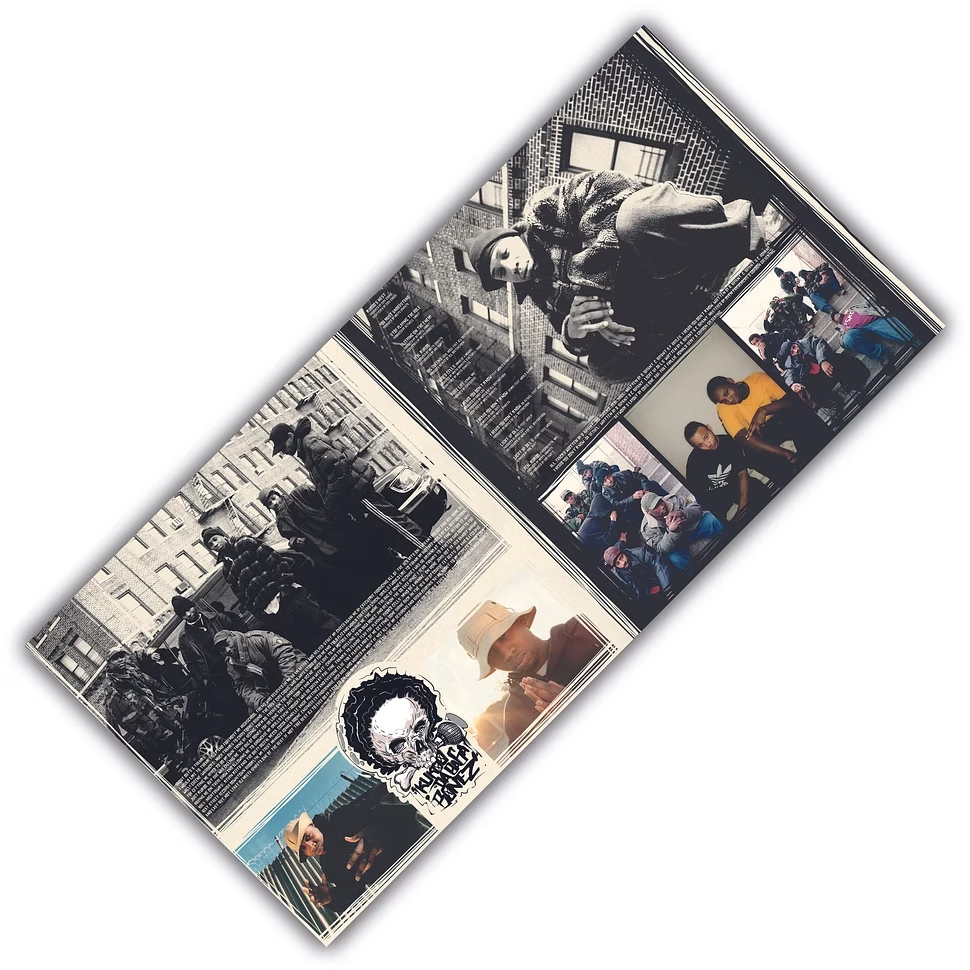
“Kukoo’s Nest” is already available on many streaming services and on Bandcamp for a digital format purchase, and was released as a limited edition on a cassette tape and vinyl, which are already sold out, but there are a few CDs left so hurry up to snatch your piece before it runs out – here’s da link!
For all others, follow the YouTube link below.
Shout out to the whole 90’s Tapes crew for making this happen. Salute!
TRACKLIST:
01 • Kukoo’s Nest [prod. Cris Cross]
02 • You Must Understand [prod. Mista Sinista]
03 • Stop Playing The Role [prod. Artwell Smart]
04 • Sleeping On The Enemy [prod. Artwell Smart]
05 • Real Kukoo [prod. Mista Sinista]
06 • Big Queens (Real Nigs) feat. Ill Distracxion [prod. Pliz]
07 • Padded Cells (Mind Of A Maniac) [prod. Artwell Smart]
08 • Trife Life [final mix] [prod. Cris Cross]
09 • I Heard You Don’t Know feat. World, Rhas Los [prod. Rhas Los; co. World]
10 • I Heard You Don’t Know [Phil Rust remix] feat. Rhas Los, World
11 • I Heard You Don’t Know (Da Sequel) feat. World [prod. World]
12 • Light Up Da L’s feat. World [prod. Rhas Los]
13 • Light Up Da L’s [Phil Rust remix] feat. World
14 • Real Kukoo [experimental mix] [prod. Mista Sinista; co. Rob Swift]
15 • Kukoo’s Nest [instrumental]
16 • You Must Understand [instrumental]
17 • Real Kukoo [instrumental]
18 • Big Queens (Real Nigs) [instrumental]
19 • Padded Cells (Mind Of A Maniac) [instrumental]
20 • I Heard You Don’t Know [instrumental]
21 • I Heard You Don’t Know [Phil Rust remix] [instrumental]
22 • Light Up Da L’s [instrumental]
23 • Light Up Da L’s [Phil Rust remix] [instrumental]

You must be logged in to post a comment.