February 13, 1996: The Day Hip Hop Became Eternal
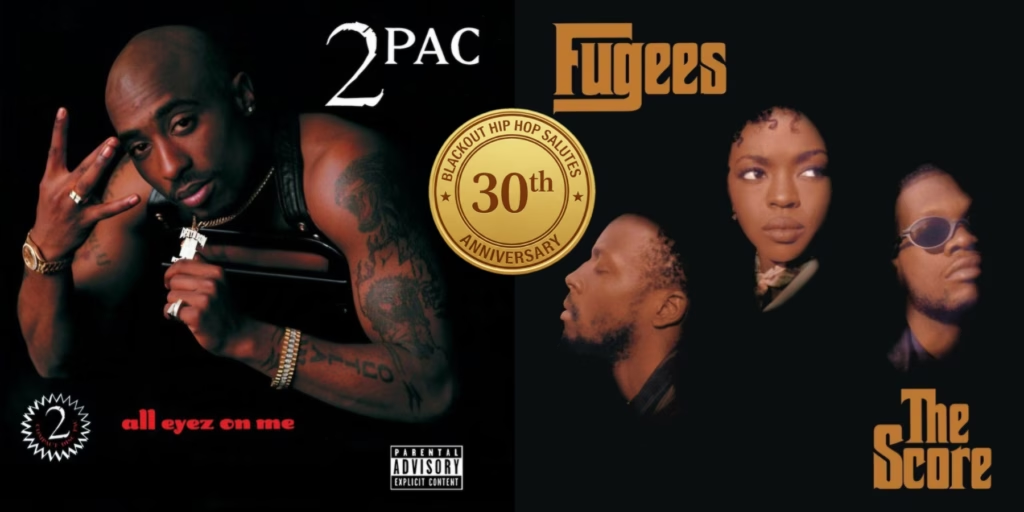
The Dual Monolith of 1996
In the history of music, certain dates stand out like lighthouses, and February 13, 1996, is definitely one of them. That Tuesday, while tensions between the East and West Coasts were at an all-time high, two projects were released that would change the rules of the game forever: 2Pac’s All Eyez On Me and The Fugees’ sophomore effort, The Score. It’s a rare occurrence for two such diametrically opposed, yet equally powerful albums to drop on the same day, defining the sound of an entire era.
2Pac – All Eyez On Me: The “Ridah” Manifesto
When Suge Knight posted the $1.4 million bail to get Tupac out of prison, signing with Death Row Records was a mere formality. What followed was anything but formal. All Eyez On Me was the first double solo album in hip hop history released for mass consumption. It wasn’t just an album; it was the cry of a man who felt both hunted and invincible.
Production-wise, the album was the pinnacle of the G-funk sound. While Dr. Dre and Daz Dillinger are often mentioned, the true MVP of this project was the late Johnny J. He produced 11 of the 27 tracks, bringing that melodic, high-gloss sound that perfectly complemented Pac’s aggressive, and sometimes paranoid, lyricism. Johnny J knew exactly how to flip soul samples, like Cameo’s “Candy” in “All About U,” into street anthems. We also can’t overlook DJ Quik’s contribution; besides producing “Heartz Of Men,” he was responsible for mixing a large portion of the album, giving it that crystal-clear definition.
Lyrically, Tupac made a significant shift here. He went from the socially conscious poet of 2Pacalypse Now to the full-blown “Ridah.” Tracks like “Ambitionz az a Ridah” and “2 of Amerikaz Most Wanted” with Snoop Dogg set the standard for gangsta rap for the decade. However, the introspection didn’t vanish—”Life Goes On” and “I Ain’t Mad at Cha” proved that behind the facade, there was still a man reflecting on mortality and old friends. The album debuted at number one on the Billboard 200 with 566,000 copies sold in its first week and eventually reached Diamond status.
The Fugees – The Score: An Audio Film from the Basement
On the other side of the country, in New Jersey, the trio consisting of Lauryn Hill, Wyclef Jean, and Pras Michel was cooking up something entirely different. Following the lukewarm reception of their debut, they were given a $135,000 advance, which they invested in equipment and a studio in Wyclef’s uncle’s basement, famously known as the “Booga Basement.” That raw, basement atmosphere gave The Score an organic, warm sound that stood in stark contrast to the Death Row aesthetic.
The Score was envisioned as an “audio film.” Lauryn Hill, with her ability to seamlessly blend rapping and soul singing, became a global superstar overnight. Their rendition of “Killing Me Softly” became a worldwide smash, but the core of the album lived in tracks like “How Many Mics” and “Ready or Not.” The production was a syncretism of everything—hip hop, reggae, jazz, and soul. Sampling Enya in “Ready or Not” or Bob Marley in “No Woman, No Cry” showcased their musical depth and intelligence.
Unlike Pac, The Fugees focused on themes of refugee identity (hence the group’s name) and social critique through the lens of black humanism. The album was a “slow burner” on the charts but eventually sold an incredible 22 million copies worldwide, winning the Grammy for Best Rap Album in 1997.
The Conflict Nobody Expected
Even though these albums were stylistically worlds apart, the coastal war eventually brought them into the same orbit. Due to his growing paranoia, 2Pac believed The Fugees were sending him subliminal disses. He was particularly sensitive to Wyclef’s association with people he blamed for the 1994 Quad Studios shooting. Lyrics in the song “Cowboys” mentioning “jokers running around with masks on” and “trying to be gangsters” were interpreted by Pac as a direct shot at his “Ridah” persona.
The response was brutal. In the track “When We Ride On Our Enemies,” Pac directly called out the group, taking low blows at Wyclef’s health and Lauryn Hill. Fortunately, this beef never escalated beyond the studio, but it remains a testament to how volatile the atmosphere of 1996 really was.
Legacy
Today, three decades later, both albums hold “five mic” ratings in retrospective reviews by The Source. All Eyez On Me stands as a monument to an unstoppable energy and the G-funk era, while The Score laid the groundwork for neo-soul and alternative hip hop. On that February 13th, hip hop showed its two faces: one aggressive, street-oriented, and luxurious, and the other intellectual, melodic, and socially engaged. Both were necessary for the culture to become what it is today.