Busta Rhymes: 30 Years Since ‘The Coming’ Debut
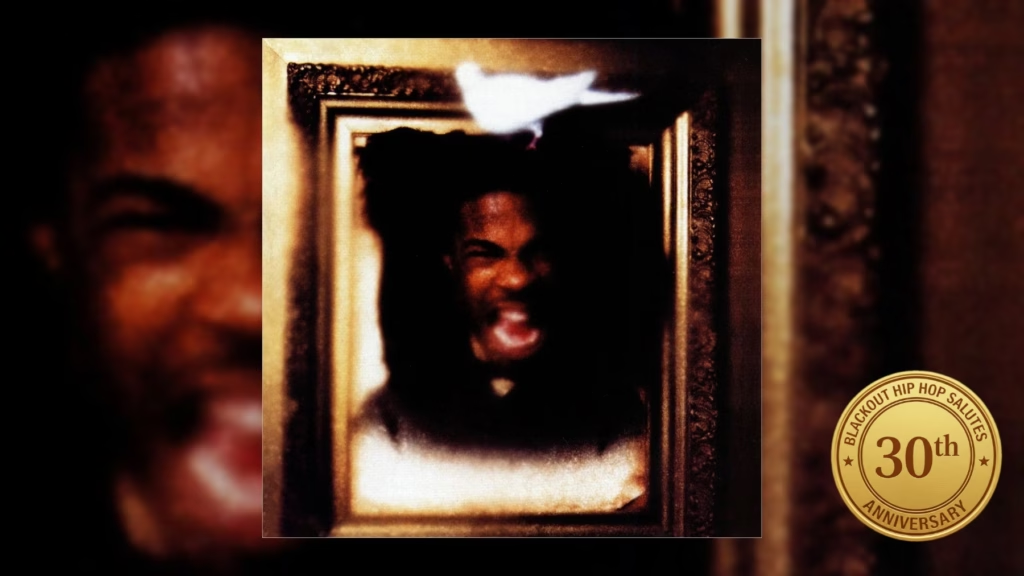
When we look back at the mid-nineties from our perspective in March 2026, it is clear that 1996 was a pivotal year for rap. While the West Coast dominated with All Eyez On Me and the New York underground was at its “grimey” zenith, Trevor George Smith Jr., better known as Busta Rhymes, decided to inject some controlled chaos into the game.
His path to solo stardom was not planned. After the group Leaders of the New School (LONS) disintegrated on camera during a 1993 Yo! MTV Raps segment, Busta was in a precarious position. Although he was already recognizable for his legendary “dungeon dragon” verse on the “Scenario” remix, he was actually afraid of a solo career, focusing instead on guest appearances to provide for his family. However, pressure from the public and mentors like Q-Tip became too great to ignore.
The Coming was recorded between 1994 and 1995, partially in Los Angeles while Busta was filming the movie Higher Learning, and partially in New York and Atlanta. What sets this album apart from average releases of that time is its production diversity. Busta assembled a crew that sounded like a dream team—from DJ Scratch and Easy Mo Bee to the then-young and relatively unknown J Dilla (then credited as Jay Dee) within The Ummah collective.
Dilla’s contribution on songs like “Still Shining” and “Keep It Movin‘” introduced that specific, airy, and unquantized rhythm that would later become his trademark. On the other hand, Easy Mo Bee delivered that classic, dark New York sound on “Everything Remains Raw” with a twisted accordion sample, providing Busta with the perfect backdrop for his vocal acrobatics.
Of course, it is impossible to talk about this album without mentioning the lead single “Woo-Hah!! Got You All in Check.” The song was a global earthquake, peaking at number eight on the Billboard Hot 100 and earning Busta his first Grammy nomination. But more than the song itself, the impact was left by the music video. Hype Williams used a fish-eye lens and vibrant colors, breaking the trend of gloomy, black-and-white videos that dominated the era. Busta defined his visual style here—hyper-energetic, bordering on a cartoon character, yet with undeniable street credibility.
The album also served as a launchpad for the Flipmode Squad. Through tracks like “Flipmode Squad Meets Def Squad,” where Redman and Keith Murray joined the cypher, the audience was introduced to Rampage, Lord Have Mercy, and Spliff Star. It was an introduction to the team dynamics that would mark Busta’s best years.
Thirty years later, Busta Rhymes is still here in 2026, fresh off receiving a star on the Hollywood Walk of Fame and an inspiring physical transformation. The Coming remains a testament to a time when one of the most talented MCs had to overcome his own doubts to become an icon. The album officially went platinum in January 1999, though Busta claims it reached that status much earlier. Regardless of the numbers, its influence on the sound and image of hip-hop is immeasurable.