10 Years of Alwasta: Retrospecting Oddisee’s Masterclass on Social Currency
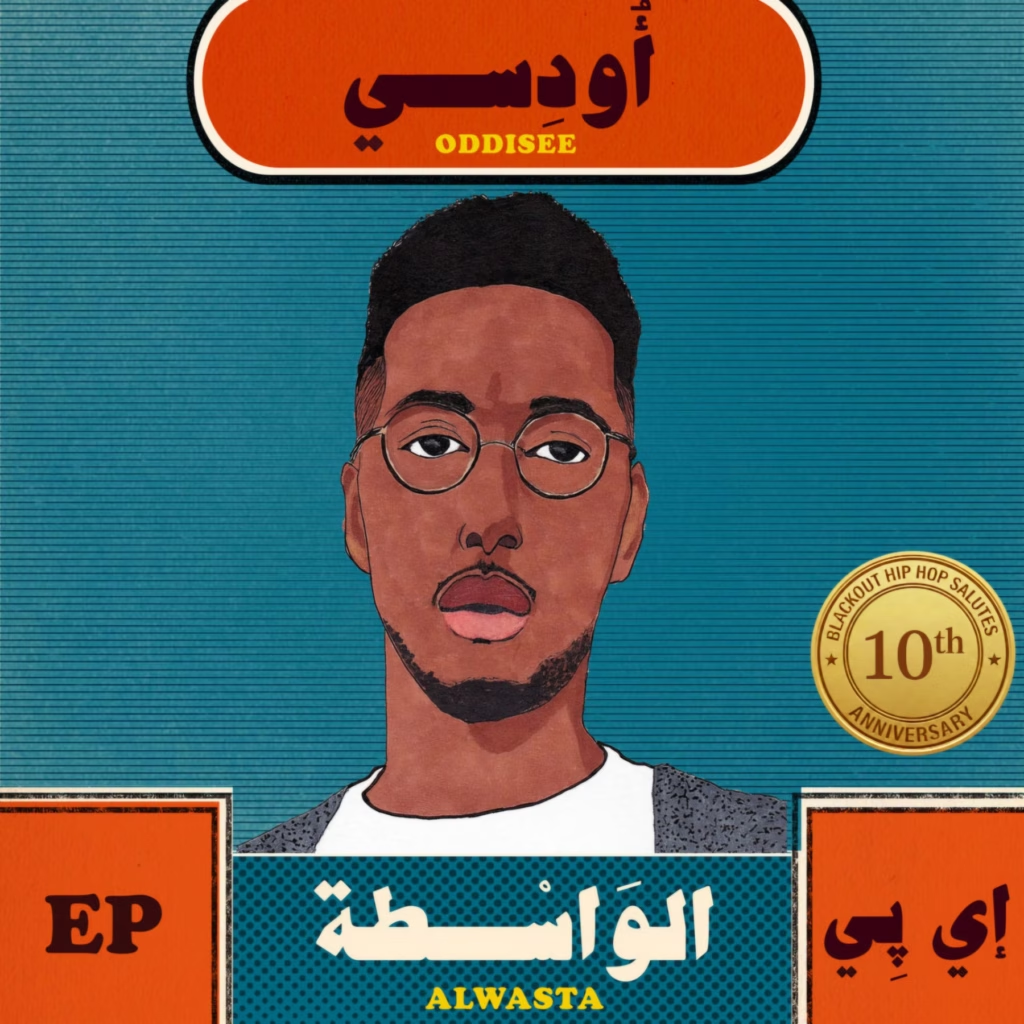
Ten years ago today, the hip-hop digital sphere was blindsided by a surprise release that arrived with little fanfare but carried more weight than most blockbuster albums. Amir Mohamed el Khalifa, better known as Oddisee, gifted us the Alwasta EP. Released via Mello Music Group on March 23, 2016, this project was far from just “filler” between studio albums; it was a manifesto on maturity, identity, and what the artist himself calls “social currency.”
Looking back from 2026, Alwasta stands as a pillar in Oddisee’s discography. The title is derived from an Arabic colloquialism that roughly translates to “the plug” or “the middleman.” It describes a community member who uses their influence and connections to bridge gaps. For an artist balancing life between Sudan and Washington D.C., this concept provided the perfect framework for seven tracks that, each in their own way, dissected American society and personal responsibility.
What immediately set Alwasta apart was its sound. While Oddisee was well-known at the time for his prowess on the Akai MPC Renaissance, this EP showcased a perfect symbiosis of sampling and live instrumentation. Enlisting his band Good Compny – with Ralph Real on keys, Dennis Turner on bass, Jon Laine on drums, and Olivier Saint Louis on guitar – the production achieved an organic warmth.
This wasn’t just boom-bap; it was “grown man rap.” Tracks like “Wouldn’t Be Surprised” delivered that raw, grimy rhythm that heads immediately gravitate toward, while “Slow Groove” at the project’s end served as a contemplative breather, reminding us that in the race for success, we often forget to slow down and observe our surroundings. Oddisee proved here that he is a virtuoso who doesn’t chase trends but builds his own ecosystem.
The heart of this project undoubtedly lies in “Lifting Shadows.” In a world that was on the brink of major political shifts in 2016, Oddisee used this track to speak on the Muslim experience in post-9/11 America. The line “I love my country, hate its politics” became a mantra for a generation feeling alienated in their own home.
An interesting piece of lore that surfaced later was that this very song was allegedly the reason Oddisee was pulled from the performer list for President Obama’s farewell party at the White House. This tells us two things: first, that his message was powerful enough to rattle institutions, and second, that Oddisee was never willing to sacrifice integrity for political clout. That uncompromising nature is exactly what earned him “wasta” with fans globally.
Alwasta served as the ideal overture for his next major full-length, The Iceberg (2017). The themes initiated here – discrimination, introspection, and analyzing causes rather than just effects – reached their full form on The Iceberg. The EP lasted only 27 minutes, but within that brief span, there wasn’t a single second of filler.
Today, ten years later, songs like “Asked About You” still sound fresh. His ability to take a simple question – “When’s the last time someone even asked you ‘Hey how you doing?‘” – and turn it into a profound social critique on the lack of empathy is why Oddisee is regarded as one of the most intelligent lyricists of his generation.
Oddisee didn’t become a star overnight; he built his career brick by brick, staying loyal to Mello Music Group and his unique vision. Alwasta remains a testament to a time when hip-hop was desperately needed as a voice of reason in a world starting to lose its way. Ten years later, we’re still very much “plugged in” to this record.